Your captivity begins at the barriers and fences erected to stop prying eyes seeing what is being done to us all; change begins when we highlight the existence of those barriers for all to see.
‘WEIRD’ Journal
‘WEIRD’ is the Free Range Network's journal, providing an alternative viewpoint on the environment, economics, and the politics of technology.
WEIRD’s starting point (the acronym, ‘White, Educated, Industrialized, Rich, Democratic’) is to disregard the status quo of consumerism, to ask, “What is required to create a good life for all human and non-human beings on the Earth?”.
The answer to that is pursued not out of ‘fear’, but by questioning technology and consumerism's relevance to human needs: by understanding “how technology works”; more importantly, how technology changes us and the world around us, not necessarily in our interest; and in response, seeking simple, practical ways in which everyone can deliberately change the role of consumption and technology in their lives.
WEIRD is free to download, and you are free to print, copy, distribute, and reuse the articles in the journal for non-profit purposes. Go to the ‘reuse’ page for details.
List of issues
All current issues of ‘WEIRD’ in reverse chronological order:
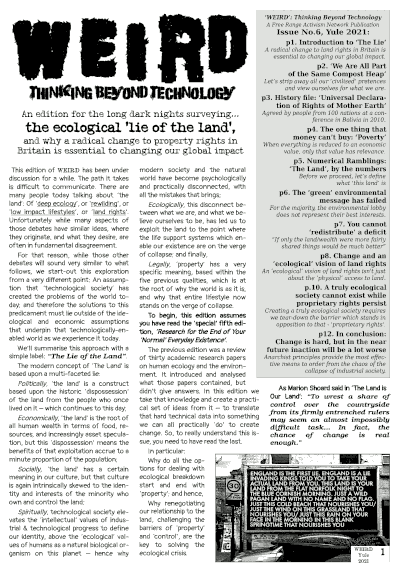
An edition for the long dark nights on why a radical change to property rights in Britain is essential to changing our global impact, looking at UK 'land rights' in the context of the ecological crisis, not simple land ownership.
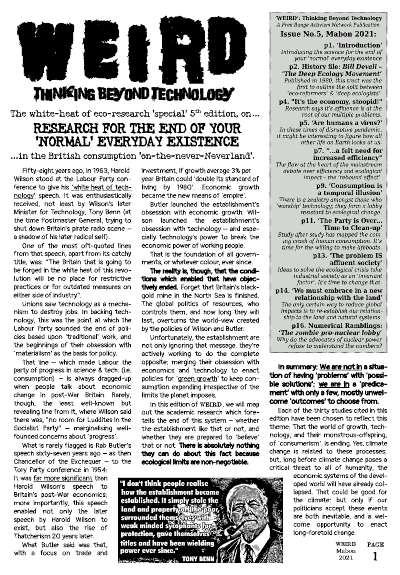
A special edition on the white-heat of eco-research about British consumption 'on-the-never-Neverland'. In summary: We are not in a situation of having ‘problems’ with ‘possible solutions’; we are in a ‘predicament’ with only a few, mostly unwelcome ‘outcomes’ to choose from.
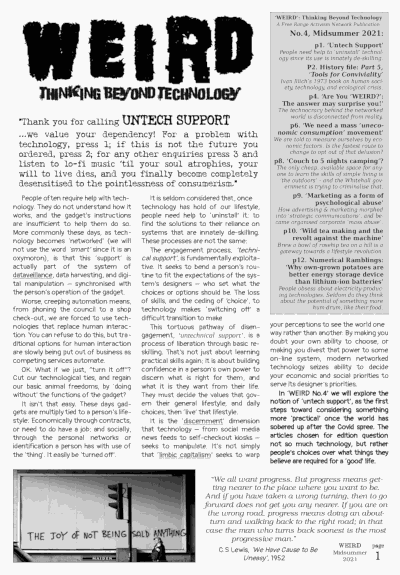
This tortuous pathway of disengagement, ‘untechnical support’, is a process of liberation through basic re-skilling. That’s not just about learning practical skills again; it is about building confidence in a person’s own power to discern what is right for them.
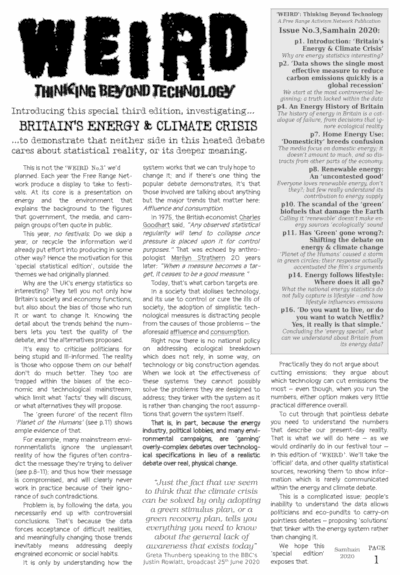
A special third edition, investigating 'Britain's Energy & Climate Crisis', to demonstrate that neither side in this heated debate cares about statistical reality, or its deeper meaning.
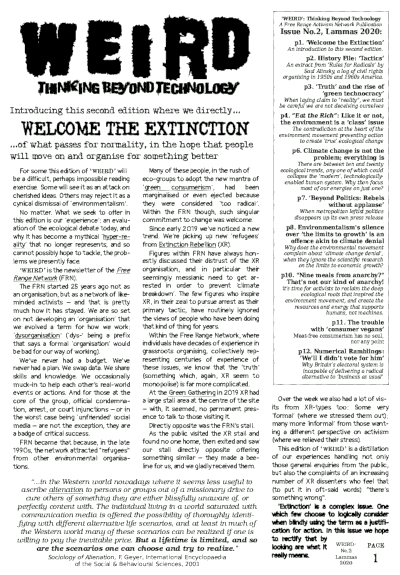
The second edition, where we directly ‘welcome to extinction’ of what passes for normality, in the hope that people will move on and organise for something better.
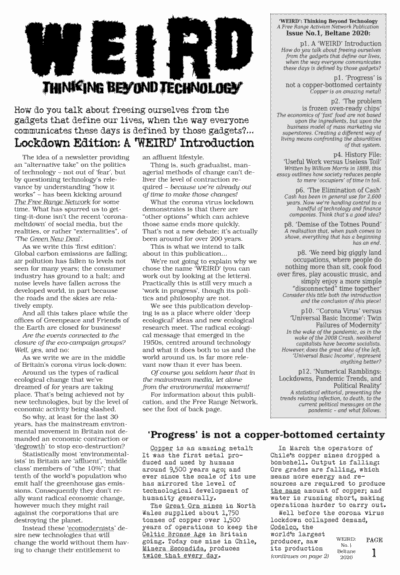
How do you talk about freeing ourselves from the gadgets that define our lives, when the way everyone communicates these days is defined by those gadgets?