
‘WEIRD’, A Free Range Journal – Issue No.5, Mabon 2021:
Research for the End of Your ‘Normal’ Everyday Existence
A special edition on the white-heat of eco-research about British consumption ‘on-the-never-Neverland’.
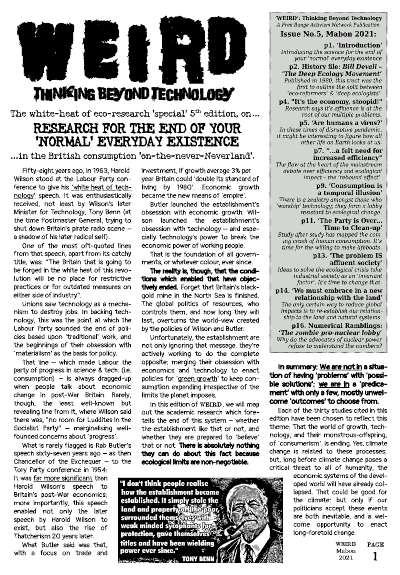
Download this edition
1A4 PDF – for printing at A4 single- or double-sided; or
2A3 PDF – for printing landscape A3 double-sided to create a folded/stapled brochure.
‘WEIRD’ is designed to print at A4, but will reduce to A5 and be about the same size as small newsprint. The A3 PDF will scale for double-sided A4 landscape
Issue No.5 Contents:
- Introduction – Introducing the science for the end of your 'normal' everyday existence
- We are not in a situation of having ‘problems’ with ‘possible solutions’; we are in a ‘predicament’ with only a few, mostly unwelcome ‘outcomes’ to choose from.
- History file – Bill Devall, ‘The Deep Ecology Movement’
- Published in 1980, this tract was the first to outline the split between ‘eco-reformers’ & ‘deep ecologists’.
- “It's the economy, stoooopid!”
- Environmentalism uses technology as a sticking plaster; research says it’s affluence driving destruction.
- Are humans a virus?
- In these times of disruptive pandemic, it might be interesting to figure how all other life on Earth looks at us.
- “...a felt need for increased efficiency”
- The fatal flaw at the heart of the mainstream debate over efficiency and ecological impact – the ‘rebound effect’.
- ‘Consumption is a temporal illusion’
- There is a religious zealotry amongst those who ‘worship’ technology; they will form a lobby resistant to change.
- ‘The Party is Over... Time to Clean-up’
- Study after study has mapped the coming crash of human consumption. It’s time for the willing to make lifeboats.
- ‘The problem IS affluent society’
- Ideas to solve the ecological crisis take industrial society as an ‘invariant factor’. It’s time to change that.
- We must embrace in a new relationship with the land
- The only certain way to reduce global impacts is to re-establish that relationship to the land and natural systems.
- Numerical Ramblings – ‘The zombie pro-nuclear lobby’
- Why do the advocates of nuclear power refuse to die, or at least see statistical reason?
Introduction – Introducing the science for the end of your ‘normal’ everyday existence
We are not in a situation of having ‘problems’ with ‘possible solutions’; we are in a ‘predicament’ with only a few, mostly unwelcome ‘outcomes’ to choose from.
Fifty-eight years ago, in 1963, Harold Wilson stood at the Labour Party conference to give his ‘white heat of technology’ speech. It was enthusiastically received, not least by Wilson’s later Minister for Technology, Tony Benn (at the time Postmaster General, trying to shut down Britain’s pirate radio scene – a shadow of his later radical self).
One of the most oft-quoted lines from that speech, apart from its catchy title, was: “The Britain that is going to be forged in the white heat of this revolution will be no place for restrictive practices or for outdated measures on either side of industry”.
Unions saw technology as a mechanism to destroy jobs. In backing technology, this was the point at which the Labour Party sounded the end of policies based upon ‘traditional’ work, and the beginnings of their obsession with ‘materialism’ as the basis for policy.
That line – which made Labour the party of progress in science & tech. (i.e. consumption) – is always dragged-up when people talk about economic change in post-War Britain. Rarely, though, the least well-known but revealing line from it, where Wilson said there was, “no room for Luddites in the Socialist Party” – marginalizing well-founded concerns about ‘progress’.
What is rarely flagged is Rab Butler’s speech sixty-seven years ago – as then Chancellor of the Exchequer – to the Tory Party conference in 1954: It was far more significant than Harold Wilson’s speech to Britain’s post-War economics; more importantly, this speech enabled not only the later speech by Harold Wilson to exist, but also the rise of Thatcherism 20 years later.
What Butler said was that, with a focus on trade and investment, if growth average 3% per year Britain could ‘double its standard of living by 1980’. Economic growth became the new means of ‘empire’.
Butler launched the establishment’s obsession with economic growth; Wilson launched the establishment's obsession with technology – and especially technology’s power to break the economic power of working people.
That is the foundation of all governments, or whatever colour, ever since.
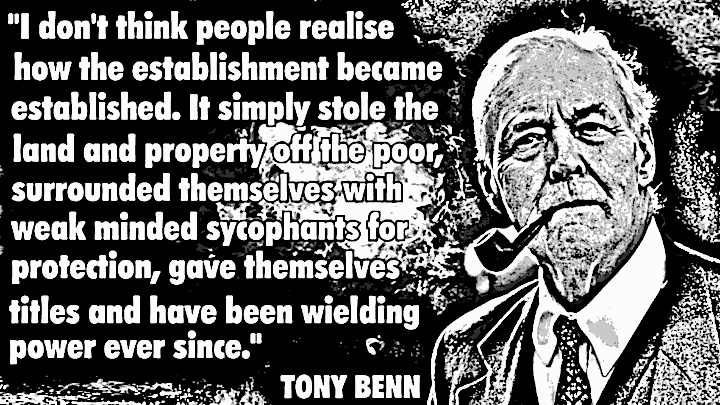
The reality is, though, that the conditions which enabled that have objectively ended. Forget that Britain’s black-gold mine in the North Sea is finished. The global politics of resources, who controls them, and how long they will last, overturns the world-view created by the policies of Wilson and Butler.
Unfortunately, the establishment are not only ignoring that message, they’re actively working to do the complete opposite; merging their obsession with economics and technology to enact policies for ‘green growth’ to keep consumption expanding irrespective of the limits the planet imposes.
In this edition of WEIRD, we will map out the academic research which foretells the end of this system – whether the establishment like that or not, and whether they are prepared to ‘believe’ that or not. There is absolutely nothing they can do about this fact because ecological limits are non-negotiable.
In summary: We are not in a situation of having ‘problems’ with ‘possible solutions’; we are in a ‘predicament’ with only a few, mostly unwelcome ‘outcomes’ to choose from.
Each of the thirty studies cited in this edition have been chosen to reflect this theme: That the world of growth, technology, and their monstrous-offspring, of ‘consumerism’, is ending. Yes, climate change is related to these processes; but, long before climate change poses a critical threat to all of humanity, the economic systems of the developed world will have already collapsed. That could be good for the climate; but only if our politicians accept these events are both inevitable, and a welcome opportunity to enact long-foretold change.
History file – Bill Devall, ‘The Deep Ecology Movement’
Published in 1980, this tract was the first to outline the split between ‘eco-reformers’ & ‘deep ecologists’.
Published in the Natural Resources Journal in Spring 1980, this long tract was the first ever not only to outline the scope of the “deep ecology movement”; but also the fundamental split between the ‘reformers’ and ‘deep ecologists’ in the environmental movement. It is as relevant today as when it was first published. Three-quarters of the document have been edited out to give just the key parts of the text. It’s well worth downloading a copy to read the entire work.
“At the point where the 1970s morphed into the 1980s – also marking the point at which neoliberalism took over as the ‘dominant paradigm’ in Western states – this paper marks the point at which science, research, and ecological consciousness united to provide a clear diagnosis of the change society needed to make; and, over the decade or two to come, was ignored by all the ‘reformers’ as “too radical”.
There are two great streams of environmentalism in the latter half of the twentieth century. One stream is reformist, attempting to control some of the worst of the air and water pollution and inefficient land use practices in industrialized nations and to save a few of the remaining pieces of wildlands as “designated wilderness areas.” The other stream supports many of the reformist goals but is revolutionary, seeking a new metaphysics, epistemology, cosmology, and environmental ethics of person/planet. This paper is an intellectual archaeology of the second of these streams of environmentalism, which I will call ‘deep ecology’…
I contend that both streams of environmentalism are reactions to the successes and excesses of the implementation of the dominant social paradigm. Although reformist environmentalism treats some of the symptoms of the environmental crisis and challenges some of the assumptions of the dominant social paradigm (such as growth of the economy at any cost), deep ecology questions the fundamental premises of the dominant social paradigm. In the future, as the limits of reform are reached and environmental problems become more serious, the reform environmental movement will have to come to terms with deep ecology… (our emphasis)
The Dominant Paradigm
A paradigm is a shorthand description of the world view, the collection of values, beliefs, habits, and norms which form the frame of reference of a collectivity of people – those who share a nation, a religion, a social class. According to one writer, a dominant social paradigm is the mental image of social reality that guides expectations in a society.
“Anyone who believes exponential growth can go on forever in a finite world is either a madman or an economist.”
Kenneth Boulding’s testimony to the US Congressional hearing on Energy Reorganization Act, 1973
The dominant paradigm in N. America includes: The belief that “economic growth,” as measured by the Gross National Product, is a measure of Progress; that the primary goal of the governments of nation states, after defence, should be to create conditions that will increase production of commodities and satisfy material wants of citizens; and that “technology can solve our problems”.
Nature, in this paradigm, is only a storehouse of resources which should be “developed” to satisfy ever increasing numbers of humans and ever increasing demands of humans. Science is wedded to technology, the development of techniques for control of natural processes (such as weather modification). Change (“planned obsolescence”) is an end in itself. The new is valued over the old and the present over future generations. The goal of persons is personal satisfaction of wants and a higher standard of living as measured by possession of commodities (houses, cars, recreation vehicles, etc.). Whatever its origin, this paradigm continues to be dominant, to be preached through publicity (i.e., advertizing), and to be part of the world view of most citizens.
Reformist environmentalism in this paper refers to several social movements which are related in that the goal of all of them is to change society for “better living” without attacking the premises of the dominant social paradigm. These reform movements each defined a problem – such as need for more open space – and voluntary organizations were formed to agitate for social changes. There has also been considerable coalition building between different voluntary organizations espousing reform environmentalism. Several reformist environmental movements have been active during the last century…
Sources Of Deep Ecology
What I call deep ecology in this paper is premised on a gestalt of person-in-nature. The person is not above or outside of nature. The person is part of creation on-going. The person cares for and about nature, shows reverence towards and respect for non-human nature, loves and lives with non-human nature, is a person in the “earth household” and “lets being be,” lets non-human nature follow separate evolutionary destinies.
Deep ecology, unlike reform environmentalism, is not just a pragmatic, short-term social movement with a goal like stopping nuclear power or cleaning up the waterways. Deep ecology first attempts to question and present alternatives to conventional ways of thinking in the modern West. Deep ecology understands that some of the “solutions” of reform environmentalism are counter-productive. Deep ecology seeks transformation of values and social organization…
I indicated in preceding pages that many thinkers are questioning some of the premises of the dominant social paradigm of the modern societies. They are attempting to extend on an appropriate metaphysics, epistemology, and ethics for what I call an “ecological consciousness.” Some of these writers are very supportive of reformist environmental social movements, but they feel reform while necessary is not sufficient. They suggest a new paradigm is required and a new utopian vision of “right livelihood” & the “good society."
Some persons, such as Aldo Leopold, have suggested that we begin our thinking on utopia not with a statement of “human nature” or “needs of humans” but by trying to “think like a mountain.” This profound extending, “thinking like a mountain,” is part and parcel of the phenomenology of ecological consciousness. Deep ecology begins with unity rather than dualism which has been the dominant theme of Western philosophy…
Numerous other writers on deep ecology, including William Ophuls, E.F. Schumacher, George Sessions, Theodore Roszak, Paul Shepard, Gary Snyder, and Arne Naess, have in one way or another called for a new social paradigm or a new environmental ethic…
According to deep ecology:
- A new cosmic/ecological metaphysics which stresses the identity (I/thou) of humans with non-human nature is a necessary condition for a viable approach to building an eco-philosophy. In deep ecology, the wholeness and integrity of person/planet together with the principle of what Arne Naess calls “biological egalitarianism” are the most important ideas. Man is an integral part of nature, not over or apart from nature. Man is a “plain citizen” of the biosphere, not its conqueror or manager…
- An objective approach to nature is required… to draw a sharp and shocking contrast with the subjective anthropocentrism.
- A new psychology is needed to integrate the metaphysics in the mind field of post-industrial society. The new paradigm requires rejection of subject/object, man/nature dualisms and will require a pervasive awareness of total intermingling of the planet earth…
- There is an objective basis for environmentalism, but objective science in the new paradigm is different from the narrow, analytic conception of the “scientific method” currently popular. Based on “ancient wisdom,” science should be both objective and participatory without modern science's subject/object dualism.
- There is wisdom in the stability of natural processes unchanged by human intervention. Human-induced disruptions of ecosystems will be unethical and harmful to men. Design for human settlement should be with nature, not against nature.
- The quality and human existence and human welfare should not be measured only by quantity of products. Technology is returned to its ancient place as an appropriate tool for human welfare, not an end in itself.
- Optimal human carrying capacity should be determined for the planet as a biosphere and for specific islands, valleys, and continents.
- Treating the symptoms of man/nature conflict, such as air or water pollution, may divert attention from more important issues and thus be counter-productive to “solving” the problems. Economics must be subordinate to ecological-ethical criteria. Economics is to be treated as a small sub-branch of ecology and will assume a rightfully minor role in the new paradigm.
- A new philosophical anthropology will draw on data of hunting/gathering societies for principles of healthy, ecologically viable societies. Industrial society is not the end toward which all societies should aim or try to aim. Therefore, the notion of “rehabiting the land” with hunting-gathering, and gardening as a goal and standard for post-industrial society should be seriously considered.
- Diversity is inherently desirable both culturally and as a principle of health and stability of ecosystems.
- There should be a rapid movement toward “soft” energy paths and “appropriate technology” and toward lifestyles which will result in a drastic decrease in per capita energy consumption in advanced industrial societies while increasing appropriate energy in decentralized villages in so-called “third world” nations…
- Education should have as its goal encouraging the spiritual development and personhood development of the members of a community, not just training them in occupations appropriate for oligarchic bureaucracies and for consumerism in advanced industrial societies.
- More leisure as contemplation in art, dance, music, and physical skills will return play to its place as the nursery of individual fulfilment and cultural achievement.
- Local autonomy and decentralization of power is preferred over centralized political control through oligarchic bureaucracies. Even if bureaucratic modes of organization are more “efficient,” other modes of organization for small scale human communities are more “effective” in terms of the principles of deep ecology.
- In the interim, before the steady-state economy and radically changed social structure are instituted, vast areas of the planet biospheres will be zoned “off-limits” to further industrial exploitation and large-scale human settlement; these should be protected by defensive groups of people. One ecologist has called such groups a “world wilderness police”…
Organization of Deep Ecology
While reformist environmentalism is content to work with the bureaucracies and legislatures of modern societies and within large-scale environmental organizations… deep ecologists harbour a deep distrust of big organizations. Indeed, deep ecologists see that during the 1970s reform environmentalists have spent great amounts of time and resources maintaining the “images” of their organizations and that political leaders view environmentalists as “just another constituency” in the balancing of interest groups…
Even though the reformist environmental movements have been remarkably free from the bitter fights between leaders found in many other social movements… these reformist groups cannot equally compete dollar for dollar and lobbyist for lobbyist with any of the major industries (such as the oil industry). In some of these groups, as well as in government agencies dealing with environmental concerns, there has been a tendency for a cadre of professional environmentalists to develop…
In sum, then, the role of deep ecology in contemporary society is liberating, transforming, questing. There is Utopia in deep ecology, a Utopia based not on man's continued and intensified conquest or domination of non-human nature but based on a questing for self-realization.
Deep ecology is liberating ecological consciousness. The writers I have cited in this paper provide radical critiques of modern society and of the dominant values of this society. They also provide, or some of them do, a profound Utopian alternative. The elaborating of or deepening of ecological consciousness is a continuing process. The goal is to have action and consciousness as one. But the development of ecological consciousness is seen as prior to ecological resistance in many of the writings cited.

This ecological consciousness may not be very well articulated except by intellectuals who are in the business of verbalizing. But they, as much as anyone, realize the limitation of just verbalizing. Consciousness is knowing. From the perspective of deep ecology, ecological resistance will naturally flow from and with a developing ecological consciousness.”
Bill Devall (2nd Dec. 1938 – 26th June 2009),
academic & deep ecologist.
“It's the economy, stoooopid!”
Environmentalism uses technology as a sticking plaster to ameliorate the impacts of human lifestyle. Research says otherwise; pointing the finger at affluent lifestyles – such as that of many middle class environmentalists.
Background research:
- Nature Communications: ‘Scientists’ Warning On Affluence’, vol. 11 art. 3107, 19th June 2020;
- Oxfam: ‘Extreme Carbon Inequality’, December 2015;
- PNAS: ‘Tracking the Ecological Overshoot of the Human Economy’, vol. 99 no. 14, 2002;
- Journal of Industrial Ecology: ‘Environmental Load from Dutch Private Consumption – How Much Damage Takes Place Abroad?’, vol. 9 no.1/2, 2005.
There is a void at the heart of contemporary environmentalism. It is a void that was deliberately created between the mid-1980s and the mid-1990s by a set of people at the heart of the environmental movement, in the USA and Europe. They created the modern movement, but at the same time created ‘the void’ and filled it with all issues they don’t talk about.
That ‘void’ is the issue of affluence, consumption, and the environment – and therefore, by default, the issue of ‘class and the environment’.
Whether it’s the politics of the right or the left, both are infatuated with consumption and growth. Even ‘green’ parties, while paying lip service to the idea of ‘ecological limits’, still seek to promote a mainstream message of affluence and materially rich lifestyles.
In recent years there have been a growing number of academic articles that are pointing a finger directly into ‘the void’. Unsurprizingly, the eco-campaign groups can’t react or promote this work as it challenges their day-to-day maintenance of ‘the void’.
‘Nature’ is one of the world’s pre-eminent science journals. In recent years it’s been split into more specialist sub-journals covering food, energy, or research.
In June 2020, ‘Nature Communications’ published an article by Wiedmann & co.: ‘Scientists’ warning on affluence’. It’s opening line left no doubt as to the subject:
“Recent scientists’ warnings confirm alarming trends of environmental degradation from human activity, leading to profound changes in essential life-sustaining functions of planet Earth… The warnings aptly describe the problems, identify population, economic growth and affluence as drivers of unsustainable trends and acknowledge that humanity needs to reassess the role of growth-oriented economies and the pursuit of affluence.”
“The smart way to keep people passive and obedient is to strictly limit the spectrum of acceptable opinion, but allow very lively debate within that spectrum – even encourage the more critical and dissident views. That gives people the sense that there’s free thinking going on, while all the time the presuppositions of the system are being reinforced by the limits put on the range of the debate.”
Noam Chomsky, ‘The Common Good’ (1998)
Criticizing economic growth is something that the core of the environment movement would never countenance in public. It is a posture popularized in the 1990s by figures such as Jonathon Porritt, Al Gore, or Stewart Brand. What mainstream environmentalism seeks to do – as outlined in ‘History File’ – is not to question the paradigm. Instead it uses techno-fixes and policy tweaks to try and make public policy, ‘less shit’.
The paper continued:
“There exists a large body of literature in which the relationship between environmental, resource and social impacts on one hand, and possible explanatory variables on the other, is investigated… Allocating environmental impacts to consumers is consistent with the perspective that consumers are the ultimate drivers of production, with their purchasing decisions setting in motion a series of trade transactions and production activities, rippling along complex international supply-chain networks.”
What this study did – in order to cope with the realities of a globalized world economy – was to dissolve the boundaries of nation states. Then look at the impacts of resource production, manufacturing, and logistics, and then account for those by the ‘average’ individual who consumed them.
This research has been undertaken, at greater-and-greater levels of detail, for the last two to three decades. It’s called ‘life-cycle analysis’; and more especially in relation to consumption, ‘ecological footprinting’ (we look at a study by one of its founders, William Rees, in the next section).
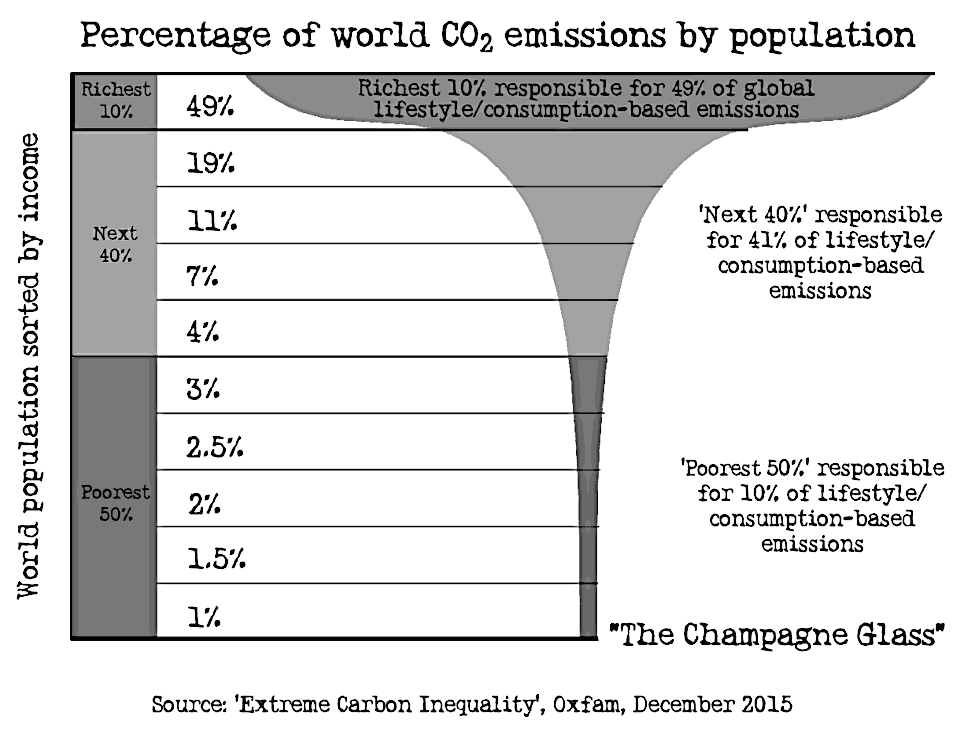
When this idea was first conceived, the UN Human Development Report published a study looking at affluence and consumption. The result of that was the ‘champagne glass’ graph.
Over a decade later, Oxfam repeated that, and found exactly the same pattern – as shown in the graph derived from their study, ‘Extreme Carbon Inequality’, right.
The conclusions of Wiedmann’s 2020 study were clearly stated – and absolutely contradict the position of many mainstream eco-campaigns/campaigners:
“The evidence is clear. Long-term and concurrent human and planetary well-being will not be achieved in the Anthropocene if affluent overconsumption continues, spurred by economic systems that exploit nature and humans. We find that, to a large extent, the affluent lifestyles of the world’s rich determine and drive global environmental and social impact. Moreover, international trade mechanisms allow the rich world to displace its impact to the global poor. Not only can a sufficient decoupling of environmental and detrimental social impacts from economic growth not be achieved by technological innovation alone, but also the profit-driven mechanism of prevailing economic systems prevents the necessary reduction of impacts and resource utilization per se.”
This research isn’t new. It has been in circulation for two decades. In 2002, Wackernagel & co. published a study in PNAS – ‘Tracking the Ecological Overshoot of the Human Economy’ – which said pretty much the same:
“Our accounts indicate that human demand may well have exceeded the biosphere’s regenerative capacity since the 1980s. According to this preliminary and exploratory assessment, humanity’s load corresponded to 70% of the capacity of the global biosphere in 1961, and grew to 120% in 1999.”
Today the figure for overshoot is estimated at around 150% to 160%.
Also 20 years ago, one of the landmark studies of Dutch consumption by Nijdam & co., ‘Environmental Load from Dutch Private Consumption – How Much Damage Takes Place Abroad?’, found that when you plotted all consumer impacts, it was food that was the greatest problem, not simply ‘fossil fuels’; and most of those impacts took place remotely – where the consumer could not perceive them – not in ‘their own backyard’ (see graph from study below).
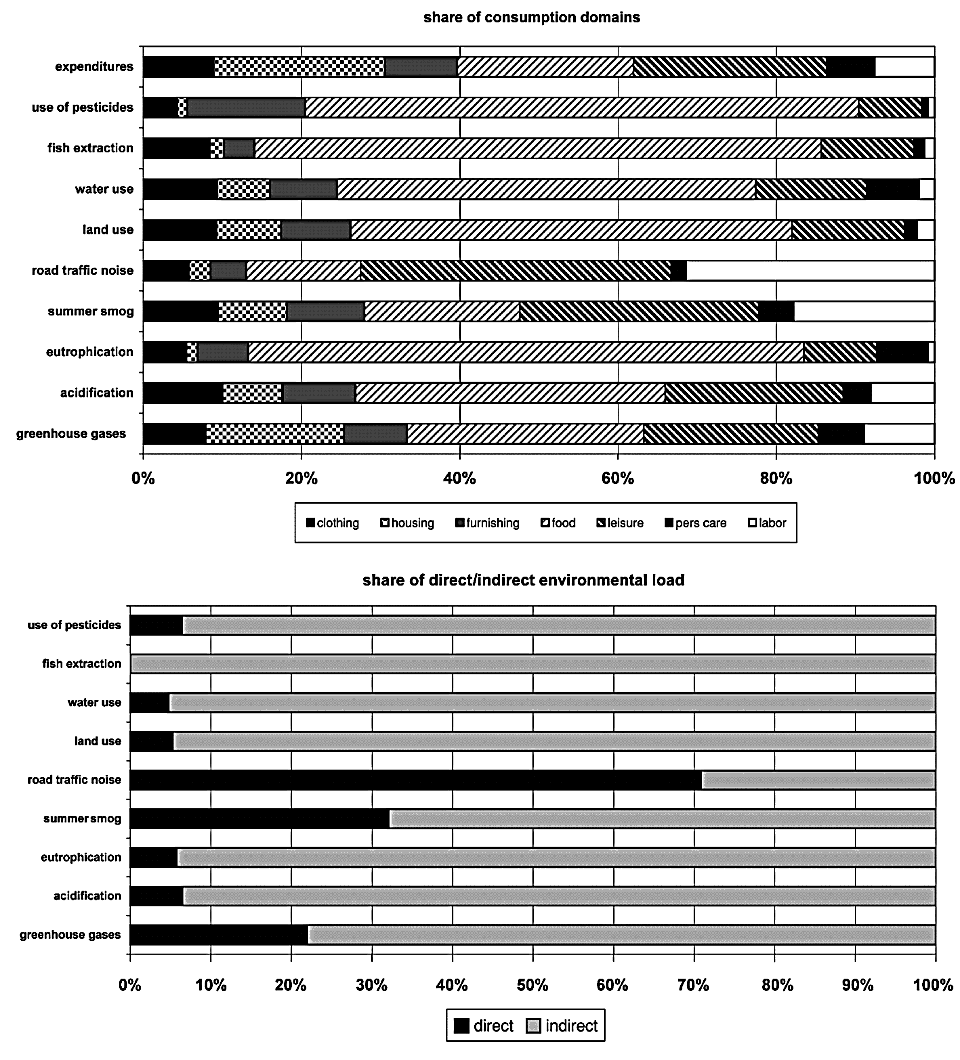
If you read the writing of environmentalists from the 1960s or 1970s, though they didn’t have the data, they innately perceived this fact. They clearly saw the importance of reducing consumption as the root of change, not new technologies.
The time has come to clearly shout this: One of the greatest obstructions to change is mainstream environmentalism and environmental journalism, because they do not represent what the evidence shows to be true.
Are humans a virus?
In these times of disruptive pandemic, it might be interesting to figure how all other life on Earth looks at us.
Background research:
- Ecological Economics: ‘Ecological economics for humanity’s plague phase’, vol.169 art.106519, March 2020;
- Ecological Economics: ‘Economics for the Future – Beyond the Super-organism’, vol.169 art.106520, March 2020;
- Energy Research & Social Science: ‘Energy transitions or additions? Why a transition from fossil fuels requires more than the growth of renewable energy’, vol.41 pp.40-43, 2019.
No… we’re serious! Just like that iconic scene from ‘The Matrix’, when Agent Smith calls humanity ‘a virus’, research suggests that – in terms of our growth and consuming impact – humans are ‘a plague on all other life on this planet’. And it is only by realizing this fact that we can we think of a way of escaping that ‘pestilent’ role.
If you want something more academic on that, see the recent review article by William Rees, ‘Ecological economics for humanity’s plague phase’:
“The human enterprize is in potentially disastrous ‘overshoot’, exploiting the ecosphere beyond ecosystems’ regenerative capacity and filling natural waste sinks to overflowing. Economic behaviour that was once ‘rational’ has become maladaptive. This situation is the inevitable outcome of humanity’s natural expansionist tendencies reinforced by ecologically vacuous growth-oriented ‘neoliberal’ economic theory.”
In the 1990s, Professor William Rees of the University of British Columbia was one of the founders of ‘ecological footprinting’ – producing studies like those seen in the previous section.
This is what’s known as a ‘review article’. Well written ‘review articles’ such as this are a good way for the public to understand an issue. It lists the key facts, but more importantly, it references all the best research on an issue; that ideally you would take the time to look-up and read as well.
What this article is talking about is the massive gap which exists between what research tells us is happening in the world, and the action we’re taking to address those problems.
As Rees points out, humans tell stories, and when the facts conflict with those stories humans simply ignore the facts.
Fundamentally this is about the impacts of exponential growth:
“It is a quirk of exponential growth that half the fossil energy ever used has been burned in just the past 35 years! The same for many other industrially important minerals and metals and waste generation and pollution.”
‘Ecological Economics’ is one of the leading global journals in this field. Thus far, what he writes is not out of character for this journal. The next bit was probably written deliberately to ruffle a few feathers, though:
“In fact, as a “choreographed hallucination”, the neoliberal paradigm contributes significantly to planetary unravelling. Neoliberal thinking treats the economy and the ecosphere as separate independent systems and essentially ignores the latter. The foundational model in mainstream analysis is the circular flow of exchange value (money) from households to firms (expenditures on goods, services and investments) and back again (wages, salaries, and dividends), in which each “self-renewing, self-feeding” cycle can be larger than the last. Thus, the goal of mainstream economists and most governments since the 1950s has been to maximize the growth of this cycle of production and consumption. True believers have such overweening confidence in human technological ingenuity that so-called ‘factors of production’ – manufactured capital, labour, knowledge, natural capital (land and natural resources/processes) – are considered inter-substitutable. In effect, the world is in thrall to a mythic construct of perpetual material growth abetted by technological progress in which even “exhaustible resources do not pose a fundamental problem”. Many production functions omit resources altogether. What could possibly go wrong?”
When reading that review of neoliberalism, and it’s faith in technology and ingenuity to solve any problem, doesn’t that sound a lot like the public statements of many leading campaign groups?
Again, to believe that all problems can be solved with some hard thinking, when the evidence says otherwise, isn’t rational; it’s delusional. Where the ‘virus’ issue emerges is simply the proportion of global resources that one species – us! – consumes:
“As human populations expand they necessarily appropriate ecological space required by other species. Human ‘competitive displacement’ of non-human organisms from their habitats and food sources is now the greatest contributing factor to plunging biodiversity. Consider that with only 0.01% of total Earthly biomass, human expansion has eliminated 83% of wild animal and 50% of natural plant biomass. From a fraction of 1% ten millennia ago, humans now constitute 36%, and our domestic livestock another 60%, of the planet’s mammalian biomass compared to only 4% for all wild species combined. Similarly, domestic poultry now comprise 70% of Earth’s remaining avian biomass.”
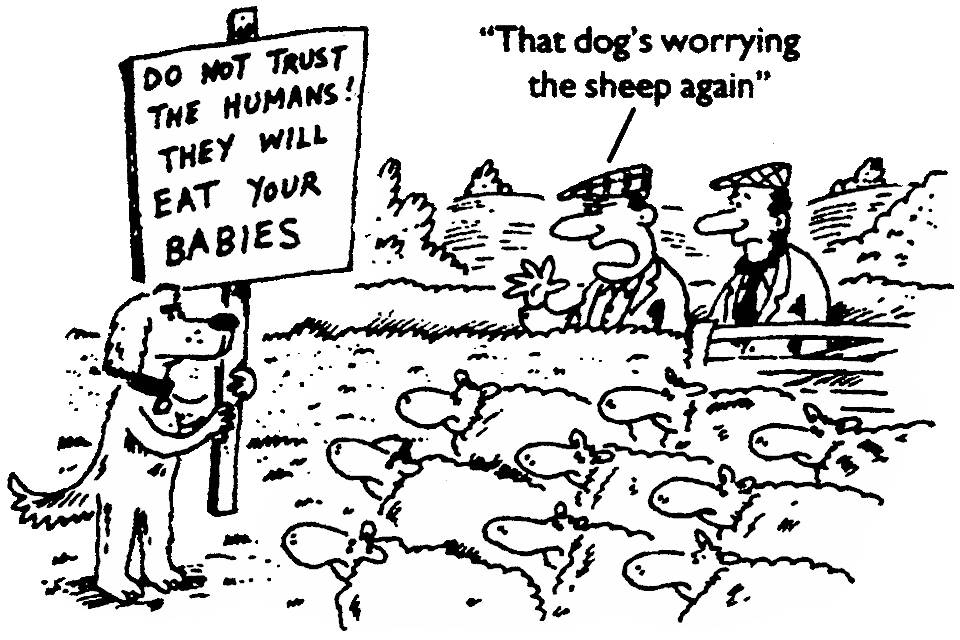
Think about that: 70% of the weight of all the birds on the planet ‘are farmed’ by humans”!
Humans are, quite simply, devouring all other life on this planet as they expand. Absolutely then, we meet Agent Smith’s definition of a ‘virus’. Certainly Rees’ conclusions to the article doesn’t leave a lot of space for ‘the delusion’ of hope:
“No doubt the political and economic mainstream – and many ordinary citizens – will see these principles and actions as impossibly radical. Again, however, they are consistent with basic theory and empirical evidence. On its current trajectory, the present system will crash; the corrective throughput reductions suggested above are in line with those of various other technical analyses.”
For the sake of balance – or rather to show Rees is not alone in a prestigious journal – let’s take another article written in ‘Ecological Economics’ at around the same time: ‘Economics for the Future – Beyond the Super-organism’, by Nate Hagens – an academic who works with many groups looking at human ecology and change:
“Major transitions in human societies over the past 10,000 years were linked to the benefits from different energy types and availability. Industrialization changed the historic human relationship of energy capture from using the daily flows of nature to using technology fuelled by large amounts of cheap fossil energy. One barrel of crude oil can perform about 1700kW-h of work. A human labourer can perform about 0.6kW-h in one workday. Simple arithmetic reveals it takes over 11 years of human labour to do the same work [as] a barrel of oil.”
What Hagens is talking about is the way that fossil energy elevates our species beyond the ordinary restrictions which apply to every other organism on the planet. As a result, humans are able to transform the environment to an extent not possible by other species – over all of ecological history.
He describes humans, therefore, as a ‘superorganism’:
“Humankind, as a species, circa 2020CE, is ecologically functioning as a mindless, energy dissipating structure. We could overcome this, but will we?… The Superorganism framing of Homo sapiens appears unflattering, yet it offers both clarity and hope. Understanding that humans in large numbers predictably self-organize by following simple energy scaling tropisms gives us a chance to visualize and prepare for what is likely to happen (financial recalibration, less energy and material throughput, more local economies, less carbon, etc.)”
OK. A bit grim, then. His diagnosis and prognosis?:
“A bunch of mildly clever, highly social apes broke into a cookie jar of fossil energy and have been throwing a party for the past 150 years. The conditions at the party are incompatible with the biophysical realities of the planet. The party is about over and when morning comes, radical changes to our way of living will be imposed. Some of the apes must sober up (before morning) and create a plan the rest of the party-goers will agree to. But mildly clever, highly social apes neither easily nor voluntarily make radical changes to their ways of living… [and] it’s morning already.”
Let’s take another opinion, from social scientist, Richard York. He examined the growth of renewable energy, and how it was changing the patters of energy use and carbon pollution that Hagens and Rees are so worried about:
“History shows us that although new energy sources have been successfully added to the global energy system, and have grown to provide a large share of the overall energy supply, it is entirely unprecedented for these additions to cause a sustained decline in the use of established energy sources. Thus, calling the addition of renewables to the energy supply an “energy transition” may not only be misleading, but also potentially counter-productive, as such claims may provide the false impression of imminent reductions in carbon emissions and thereby suppress efforts to bring about a genuine transition away from fossil fuels.”
This has been the charge made by a number of the more ‘radical’ eco-campaigners – as in the recent documentary, ‘Bright Green Lies’ – that environmentalism’s focus on renewable energy does not reduce fossil fuel use. It just adds more energy to fuel global consumption.
York concludes:
“The rapid and continuing growth of total energy consumption – which is connected with continuing economic growth – makes it so that removing an energy source like fossil fuels is very difficult, even when the production of other energy sources is growing. Therefore, challenging the forces that push for relentless economic growth may be necessary to change the historic pattern of energy additions without transition.”
Whether from the point of view of resource use (Rees), human ecology (Hagens), or the trends in how humans use energy and resources (York), the results come back to this same point: It’s the total level of consumption that drives ecological decline, not simply fossil fuel use. York’s work is even more condemning, as while environmentalists talk of ‘transition’, in fact the ‘viral’ nature of humanity is just doing ‘business-as-usual’ with a different source of energy.
“...a felt need for increased efficiency”
The fatal flaw at the heart of the mainstream debate over efficiency and ecological impact – the ‘rebound effect’.
Background research:
- PLOS One: ‘Is Decoupling GDP Growth from Environmental Impact Possible?’, vol.11(10) art.e0164733, 14th October 2016;
- Nature Climate Change: ‘Pathways of human development and carbon emissions embodied in trade’, vol.2 pp.81-85, February 2012;
- Frontiers in Energy Research: ‘The Rebound Effect and the Jevons' Paradox – Beyond the Conventional Wisdom’, vol.7 art.90, 10th September 2019;
- Renewable and Sustainable Energy Reviews: ‘Energy efficiency and economy-wide rebound effects – A review of the evidence and its implications’, vol.141 art.110781, March 2021.
In 1949, Aldous Huxley wrote a letter to George Orwell, telling him what he thought of his new book, ‘Nineteen Eighty-Four’. The quote below is an extract from that (now famous) letter.
Shortly after is a quote from Huxley’s, ‘Brave New World Revisited’. A decade later, he extends this idea. In the modern world ‘efficiency’ is not a means to encourage change; it is a prison in which people ensnare themselves.
“I feel that the nightmare of Nineteen Eighty-Four is destined to modulate into the nightmare of a world having more resemblance to that which I imagined in Brave New World. The change will be brought about as a result of a felt need for increased efficiency.”
Letter from Aldous Huxley to George Orwell, reviewing his book, ‘Nineteen Eighty-Four’ (1949)
Mainstream environmentalism too often says we need to ‘improve efficiency’. As Huxley outlines, it does not question the paradigm of consumerism; it just encourages people to modify their behaviour to make their consuming choices ‘better’.
What a long-standing body of research shows is that environmental impacts are directly related to economic activity. The more stuff or wealth we create, the higher the level of global impact.
“The nature of psychological compulsion is such that those who act under constraint remain under the impression that they are acting on their own initiative. The victim of mind-manipulation does not know that he is a victim. To him the walls of his prison are invisible, and he believes himself to be free. That he is not free is apparent only to other people. His servitude is strictly objective.”
Aldous Huxley, ‘Brave New World Revisited’ (1959)
The solution to this amongst governments and economists is the idea of ‘decoupling’: That by using better technology, and new sources of energy, we can cut that link between pollution and affluence. Quite literally, half of all the cuts in emissions under the Paris climate agreement, and just about every national environmental plan, is predicated on the existence of this idea.
Let’s begin with a study published in the respected open access peer-reviewed journal, PLOS One, by Ward & co. in 2016 – ‘Is Decoupling GDP Growth from Environmental Impact Possible?’. In this study, Ward & co. decided to test this idea to see if it was valid:
“The question as to whether human society can decouple economic growth – defined as growth in Gross Domestic Product (GDP) – from environmental impacts has not been settled. The decoupling debate itself is polarized with a preponderance of neo-classical economists on one side (decoupling is viable) and ecological economists on the other (decoupling is not viable). The divide over the compatibility of economic growth and environmental limits extends into the general public with substantial polarization in ideas of decoupling, dematerialization, and limits to growth.”
They took data on economic activity and pollution from some of the major global economies. Then they had to trace how those figures were modified by the large amount of trade between countries, which exported pollution from one state to another. Then they looked to see if countries has managed to break the link:
“Decoupling is defined as either ‘relative’ (aka ‘weak’) or ‘absolute’ (aka ‘strong’). Relative decoupling refers to higher rates of economic growth than rates of growth in material and energy consumption and environmental impact. As a result, relative decoupling implies a gain in efficiency rather than removal of the link between impact and GDP. Recent trends (1990 to 2012) for GDP, material use and energy use in different countries and regions exhibit different behaviour.”
After doing their sums and unravelling all the complicated statistics, their conclusion is on page 10:
“Our model demonstrates that growth in GDP ultimately cannot plausibly be decoupled from growth in material and energy use, demonstrating categorically that GDP growth cannot be sustained indefinitely. It is therefore misleading to develop growth-oriented policy around the expectation that decoupling is possible. However, we also note that GDP has been shown to be a poor proxy for societal well-being, something it was never designed to measure, and GDP growth is therefore a questionable long-term societal goal in any case.”
Some in the ‘bright green environmentalism’ camp refuse to believe these results – it strikes at the heart of how they believe we can ‘save the planet’ without painful lifestyle change.
The first reason for these results is trade. The affluent world now import most of their goods from other states. As emissions are only counted on a state-by-state basis, though, by moving their polluting industries abroad they can ignore the pollution. This makes it appear as if their economy has gotten ‘cleaner’.
A 2012 study by Steinberger & co. – ‘Pathways of human development and carbon emissions embodied in trade’ – found that the trends underlying this also demonstrate the disparities that consumption creates.
As resource and energy consumption increase, very quickly human income and quality of life increase too. That reaches a threshold, though – around the living standards in China or part of South America – where the level of increase rapidly falls with increasing consumption. Beyond that point, where the most ‘affluent’ countries lie, they are burning lots of extra resource to create affluent lifestyles, but it produces very little extra ‘well-being’ for that extra consumption.
This again confirms what Ward & co. found. Burning extra resources to create affluent lifestyles requires a proportionately larger input to maintain that material status. This means the efficiency savings from new technology do not lead to a significantly lower impact overall.
Perhaps the strongest evidence for why decoupling is not possible comes from research on the ‘rebound effect’ This is quite complicated; let’s use an analogy:
Put some new insulation in your house. Your heating bills go down and you save money. What do you do with the money? Do you throw it away? Do you work less hours and not get paid as much? Or do you go out and buy something else with the saved cash?
If the pollution created by the new thing you buy has the same energy or pollution footprint as the energy saved in the home, you will have saved nothing. If it has a higher footprint, then you will have actually made matters worse.

Only when you save energy or cut consumption, and then do not re-spend ANY of the savings made at all, can you keep 100% of the energy or pollution your action saved.
This is the root of why decoupling does not work – people will not reduce consumption without re-spending the savings on something else.
This effect has been found operating in different ways. A recent editorial in the journal, ‘Frontiers in Energy Research’ – ‘The Rebound Effect and the Jevons' Paradox – Beyond the Conventional Wisdom’ – highlighted, there are many different ways in which the rebound of efficiency can be measured. Economic, material, psychological; and these complex mechanisms combine to defeat the objective of saving pollution.
Unfortunately there is little evidence that, across the entire human economy, decoupling has any great effect – and ultimately ‘the rebound effect’ perpetuates the impacts of consumption overall.
One of the best recent studies to analyse ‘the rebound’ is by Brockway & co., ‘Energy efficiency and economy-wide rebound effects – A review of the evidence and its implications’. As they outline in the abstract:
“The majority of global energy scenarios anticipate a structural break in the relationship between energy consumption and gross domestic product (GDP)… However, there are few precedents for absolute decoupling, and current global trends are in the opposite direction. This paper explores one possible explanation for the historical close relationship between energy consumption and GDP, namely that the economy-wide rebound effects from improved energy efficiency are larger than is commonly assumed.”
What they mean by ‘economy wide’ is that yes, impacts may be saved in one place in the economy; but that just enables more consumption to take place somewhere else in the economy to negate it. As they say in their conclusions:
“It seems reasonable to conclude that economy-wide rebound effects erode more than half of the energy savings from improved energy efficiency. This is a larger figure than is commonly found in studies of direct rebound effects for consumers, and the focus on the latter… may have diverted attention away from the possibility of larger rebound effects at the economy-wide level.”
What this means practically is to save ‘X’, you have to increase efficiency by twice the value of ‘X’ because half of that will simply be re-spent as savings in the economy. The idea of ‘efficiency’ does not ‘save the world’; it just perpetuates the paradigm of ‘consumption’.
‘Consumption is a temporal illusion’
There is almost a religious zealotry amongst those who ‘worship’ technology, and the consumption it enables in their daily lives. As reality dawns, this group will form a lobby resistant to change purely due to that warped perspective – and many of them will call themselves “environmentalists”.
Background research:
- Global Environmental Change: ‘Providing decent living with minimum energy – A global scenario’, vol.65 art.102168, November 2020;
- Nature Energy: ‘Large inequality in international and in-tranational energy footprints between income groups and across consumption categories’, vol. 5 pp.231–239, March 2020;
- Global Sustainability: ‘Unequal distribution of household carbon footprints in Europe and its link to sustainability’, vol. 3 art. E18, 6th July 2020;
- Sustainable Development: ‘Creating Sustainable Identities – The Significance of the Financially Affluent Self’, vol. 18 pp. 123-134, March 2010.
Finding solutions to our future needs requires some difficult decisions. Those decisions are innately tied to our lifestyle, and hence the individual identity that high levels of resource consumption confer on those able to have that.
Not to mince words here: ‘We are truly fucked’. If Covid has created a pandemic of discontent that puts either climate change or Brexit into a shadow, exactly what do you think will happen when we have to tell affluent consumers that reality requires them to have their toys taken away? (note, this was also foreseen by Ivan Illich in his 1973 book, review in WEIRD No.4, ‘Tools for Conviviality’).
Unless there’s a massive break-out of public civility, perhaps the result of billionaire lobbyists being denied the ability to quietly buy media coverage and political influence, then there will be no ‘liberal’ way to negotiate this impasse.
There are many studies that map exactly the scale of contraction required. A good place to start is the paper by ‘Providing decent living with minimum energy – A global scenario’ by Millward-Hopkins & co., from ‘Global Environmental Change’, published in 2020. From the beginning, they don’t try to hide the facts:
“It is increasingly clear that averting ecological breakdown will require drastic changes to contemporary human society and the global economy embedded within it.”
This study tries to find a path through the limitations of climate change and resource depletion on one side, and justice and fairness on the other. It takes known technologies, and how they might be deployed globally, and then finds what we have to deal with.
It begins by defining the problem:
“The annual energy use of late-Palaeolithic foragers is estimated to have been around 5GJ per person… By 1850… average global primary energy consumption rose to over 20GJ/person. Today, after 150 years of fossil-fuelled industrial development, it has reached 80 GJ/person. In absolute terms, total global primary energy use has risen from around 1,000,000GJ in the late-Palaeolithic to nearly 600,000,000,000GJ.”
The study looks at what constitutes our ‘essential’ needs – for everyone on the planet – and then finds ways to create the energy to support that. That’s not just food and shelter. It also includes transport, education, health care, and other ‘advanced’ services we regard as a basic measure for human well-being. They found this requires 13GJ to 18GJ/person per year.
Those living on the globally comparable equivalent of less than $6,000 dollars a year don’t use that much already – so can have more. When you get to the equivalent of $15,000 per year, those people are already 2 to 15 times the ‘minimum’ level.
Needless to say, this doesn’t look good for the world’s most affluent states, where individuals can easily consume 200 times the ‘minimum’:
“A central lesson of science is that to understand complex issues (or even simple ones), we must try to free our minds of dogma and to guarantee the freedom to publish, to contradict, and to experiment. Arguments from authority are unacceptable.”
Carl Sagan, ‘Billions and Billions’ (1997)
“We find that, with a combination of the most efficient technologies available and radical demand-side transformations… the final energy requirements for providing decent living standards to the global population in 2050 could be over 60% lower than consumption today. In countries that are today’s highest per-capita consumers, cuts of ~95% appear possible while still providing decent living standards to all.”
Oh my God! A 95% cut in consumption! Surely that takes us bask to the Stone Age?!
No. The level of energy growth in the second half of the Twentieth Century was so steep that you don’t have to go back very far to make an appreciable cut in energy consumption – as they state clearly in the abstract:
“We find that global final energy consumption in 2050 could be reduced to the levels of the 1960s, despite a population three times larger.”
Britain imports the value of perhaps two or three times the amount of energy it consumes in goods and resources – from steel, to fertilizer, to plastic cups. Our government refuses to count that ‘embodied energy’.
The world today is consuming ‘primary energy’ equivalent to about 560 million tonnes of oil. In 1965 that was about 155 million tonnes – 3.6 times less. Despite the larger population, we consume that energy more efficiently than fifty-odd years ago.
Their study leaves perhaps its most controversial statement to the ‘discussion’ at the end:
“To suggest where consumption can be reduced most effectively, it would then be useful to take current energy consumption data and distinguish so far as is possible luxury, wasteful, and sufficiency based consumption”.
‘Luxury’. ‘Wasteful’. These are words that raise the rage of Telegraph and Mail readers, secure in their sense of privilege and entitlement. Even suggesting they cut consumption ‘a little’ in the past has created a torrent of abuse.
Here it’s worth bringing in a very different study published around the same time in ‘Nature Energy’ by Oswald & co., Large inequality in international and in-tranational energy footprints between income groups and across consumption categories:
“We calculate final energy footprints; that is, the energy embodied in goods and services across income classes in 86 countries, both highly industrialized and developing. …the consumption share of the bottom half of the population is less than 20% of final energy footprints, which in turn is less than what the top 5% consume.”
You’ve seen an illustration of that already – albeit expressed in terms of carbon emissions.
It is impossible to separate the issue of consumption and global justice – precisely because in a resource constrained world, the fact that a tiny minority consume more than a large part of the global population will always be a source of injustice and conflict. Climate change makes people raise the spectre of wars over water or farmland. The fact is a small group of the world’s wealthy have been waging a global war on the world’s poor since the Eighteenth Century rise of world trade, based first on slavery, then fossil fuels.
As the paper outlines towards the end, in raw energy terms, these trends are playing out what we see generally:
“With economic growth as a core goal of political and economic processes, it is likely that this pattern will proceed and even aggravate in the future, particularly if economic growth is mostly distributed to high-income people as suggested by recent evidence. High-income individuals will then further expand their demand of high energy intensity goods and their footprint will increase.”
This is why ecological economics has become so political, whether it likes it or not. It identifies and contradicts the concentrated power of those who dictate global policy – the affluent. But as Marx said, “The philosophers have only interpreted the world, in various ways. The point, however, is to change it.”
Let’s narrow the focus – bringing those inequalities back nearer home. That’s because those same global inequalities are replicated at home too.
A study published in ‘Global Sustainability’ by Ivanova and Wood, ‘Unequal distribution of household carbon footprints in Europe and its link to sustainability’, also in 2020, collected data to show how affluence across continent of Europe varies massively:
“We need a good understanding of household carbon distributions in order to design equitable carbon policy… The top 10% of the population with the highest carbon footprints per capita account for 27% of the EU carbon footprint, a higher contribution to that of the bottom 50% of the population.”
Again, you should be thinking of the ‘champagne glass’ graph earlier – but this time operating within Europe, not globally.
The structure of the Paris climate agreement enshrines this global, regional, and national disparity in pollution in its text. It does not try to change that disparity; which is why the agreement focusses upon doubtful and fictitious technological means to meet the insufficient target in the treaty. Even so, the most developed countries still, today, do not have workable plans to meet those minimal commitments.
The graph below shows the distribution of household footprints in the EU, sorted by wealth. Look at that and ask yourself, why has there been such a huge lobby to reopen international air travel, shut-down in the pandemic? It’s because 70% of all air travel is used by just the most affluent 15% of the population – and over half the population of Britain do not fly at all in most years.
The study concludes (note that the study is based on data before Brexit, so it does include the UK):
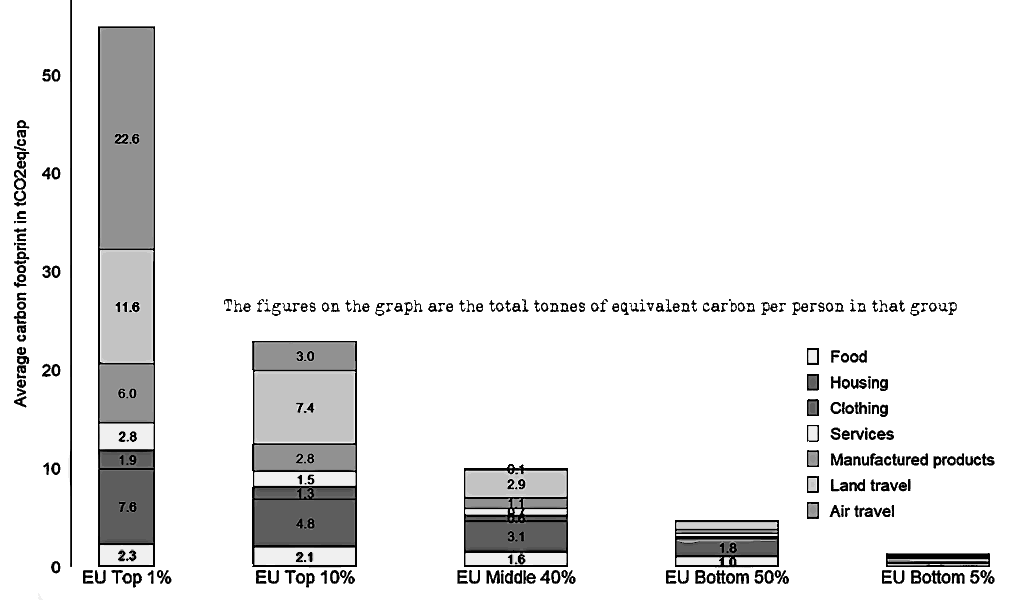
“The EU has committed to an action programme towards a good life for all within the planetary boundaries… In our analysis of the carbon footprint (CF) of European households using household-level consumption data, we find significant inequality in the distribution of CFs. The top 10% of the EU population with the highest CFs contribute more carbon compared to the 50% of the EU population with the lowest CFs. Only 5% of the EU households live within a CF target of 2.5 tCO2 eq/cap, while the top 1% of EU households have CFs of 55 tCO 2 eq/cap. The households with the highest CFs are by and large the households with the highest levels of income and expenditure.”
The first study in this section said we needed to cut consumption by 60%. To meet the EU’s 2.5 tonne target, the “middle 40%” in the graph below have to cut by about 75%. The “bottom 50%” need only cut by about half. The “top 10%”, though, must cut 95%.
This should illustrate clearly that, although the level of reductions required to reduce consumption or prevent climate breakdown might seem massive overall, when you do the sums only a small group are really badly affected. The problem for the rest of us, though, is that is the group with all the wealth and political power.
At some point we have to call ‘bullshit’ on the mainstream debate over climate change. It bears no relationship to the data. If we really do live in a world where, to use repeated Conservative politicians’ phrase, “we’re all in this together”, then, to use another conservative mantra, ‘the polluter must pay’.
Of course, that isn’t going to happen; and we secretly hide that reality in our daily lives in order to create a vestige of hope. While we all explicitly know that in everyday life the interests of the rich and powerful are protected far more than the average person, we implicitly delude ourselves every time we talk about the measures we need to take to protect the environment.
That brings us to the last study in this section, by Victoria Hurth, ‘Creating Sustainable Identities – The Significance of the Financially Affluent Self’, published in the journal ‘Sustainable Development’ in 2010. This examines a intriguing contradiction:
“This paper uses identity theory and postmodern identity perspectives to analyse why high-income groups often have values, attitudes and intentions to consume sustainably, yet tend to have the highest energy consumption of any group.”
Why is it that most people we would call ‘environmentalists’ tend to be white, affluent, and materially high consuming? The study’s conclusion:
“…it is likely that the affluent identity is overpowering the environmentalist identity where a person holds both identities simultaneously. This is because the affluent identity elicits strong social support, provides self-esteem rewards and therefore is likely to be highly salient and prompt strong commitment. On the other hand, the environmentalist identity is often negatively perceived and is stereotypically associated with values of frugality and self-denial.”
In short, the affluent are socialized to be affluent, and that over-rides any rational perception of the need for change. Instead it deflects people into pointless tokenistic action to address those perceptions.
Returning to the graph above though, if you are in the bottom 50% then it is entirely possible that ‘green consumerist’ actions might reduce your impact by the level required. Those actions only create small changes in impact, but it is entirely possible they might create the 50% cut required.
If you’re in that ‘middle 40%’, though, only radical lifestyle change can do that. That’s because efficiency, or changing energy sources, can only deliver a minimal cut – and certainly not the 75% cut required.
The fact many affluent environmentalists reject the so called “hair shirt” ideas of low consuming deep ecologists – as in, the idea of a frugal, minimal lifestyle, such as the poorer people in Britain are made to live – is not because of the lifestyle itself; it’s because, as this study describes, they have been taught to dislike that frugal way of living due to its association with the poorer, low status members of society.

“For whence did Dante get the material for his hell, if not from this actual world of ours? And indeed he made a downright hell of it.”
Arthur Schopenhauer, ‘The World as Will and Representation’ (1844)
That’s not reality though. That’s prejudice based upon an unjust apportionment of the products of the Earth.
Why is a consumption a ‘temporal illusion’? It’s because it only made sense for a minuscule moment of human history. The reality is that this moment is ending; and there’s nothing that can be done to avoid that.
The conventional, ‘bright green’ ideas of environmentalism – such as greater efficiency, or circular/cleaner production – have no basis is statistical reality. That’s because they do not influence the consumption of resources or the production of pollution enough to off-set the excessively high levels of consumption of the affluent consumer.
At the same time though, it’s no wonder that affluent environmentalists shy away from truly ‘radical’ solutions to the ecological crisis, because that is how they have been conditioned by society. That doesn’t make their refusal of these options ‘rational’, though.
‘The Party is Over... Time to Clean-up’
Ever since ‘The Limits to Growth’ party-pooped the growth fetish of ‘The Affluent Society’ in 1972, study after study has mapped the coming crash of human energy and resource consumption. It's an inescapable reality that too few are willing to plan for. It’s time for the willing to make lifeboats.
Background research:
- Global Environmental Change: ‘A comparison of The Limits to Growth with 30 years of reality’, vol.18 no.3 pp.397-411, August 2008;
- Journal of Industrial Ecology: ‘Update to limits to growth – Comparing the World3 model with empirical data’, vol.25 no.3 pp.614-626, June 2021;
- Frontiers in Conservation Science: ‘Underestimating the Challenges of Avoiding a Ghastly Future’, vol.1 art.615419, January 2021;
- Energies: ‘Through the Eye of a Needle – An Eco-Heterodox Perspective on the Renewable Energy Transition’, vol.14 art.4508, July 2021.
There’s a lovely line in the William E. Rees paper discussed earlier that’s worth repeating. It exactly sums up our predicament:
“In effect, the world is in thrall to a mythic construct of perpetual material growth abetted by technological progress in which even “exhaustible resources do not pose a fundamental problem”. Many production functions omit resources altogether. What could possibly go wrong?”
Modern economics violates the laws of physics. It’s a self-referential ‘social construct’ (to use Rees’ phrase) that represents an idealized view of wealth, not the real world we all live in.
When the book, ‘The Limits to Growth’ was published in 1972, the economic lobby used all their might to vilify it. And that continued for almost 20 years until climate change, and ‘Agenda 21’, appeared to distract them. The core analysis of the book never went away though – and it has been refined by repeated studies ever since.
Though ‘Limits to Growth’ is occasionally referenced – in most cases as a negative, ‘Malthusian’ example of why “technology will save us” – there has still been follow-up research.
In 2008 Graham Turner, then working at the prestigious Australian CSIRO, published a paper, ‘A comparison of The Limits to Growth with 30 years of reality’, that updated the projections of limits to growth (LtG) using the wealth of new data that was not available in the late 1960s:
“The main purpose of this paper is to compare LtG scenario outputs of the World3 model produced in 1974 with 30 years of observed data covering 1970-2000. This comparison is made to distinguish between scenarios in terms of approximate magnitudes and trends of key variables, and is therefore commensurate with the purpose of the LtG modeling, i.e., to understand different global economic behaviour modes rather than being strictly predictive.”
The paper is very long and detailed, as it discusses different models and the use of assumptions and data. For that reason let’s skip to the conclusion:
“As shown, the observed historical data for 1970-2000 most closely match the simulated results of the LtG ‘standard run’ scenario for almost all the outputs reported; this scenario results in global collapse before the middle of this century. The comparison is well within uncertainty bounds of nearly all the data in terms of both magnitude and the trends over time.”
The group behind ‘Limits to Growth’ published updated versions of the book in 1973, 1993, and 2004. The version produced by one of the previous authors in 2012 did produce more interest – coming on the heels of the global financial crash.
In 2012, the Smithsonian Institute held an anniversary event, and published an article in Smithsonian Magazine. The graph from the article, below, shows the ‘standard run’ with more recent data on top.
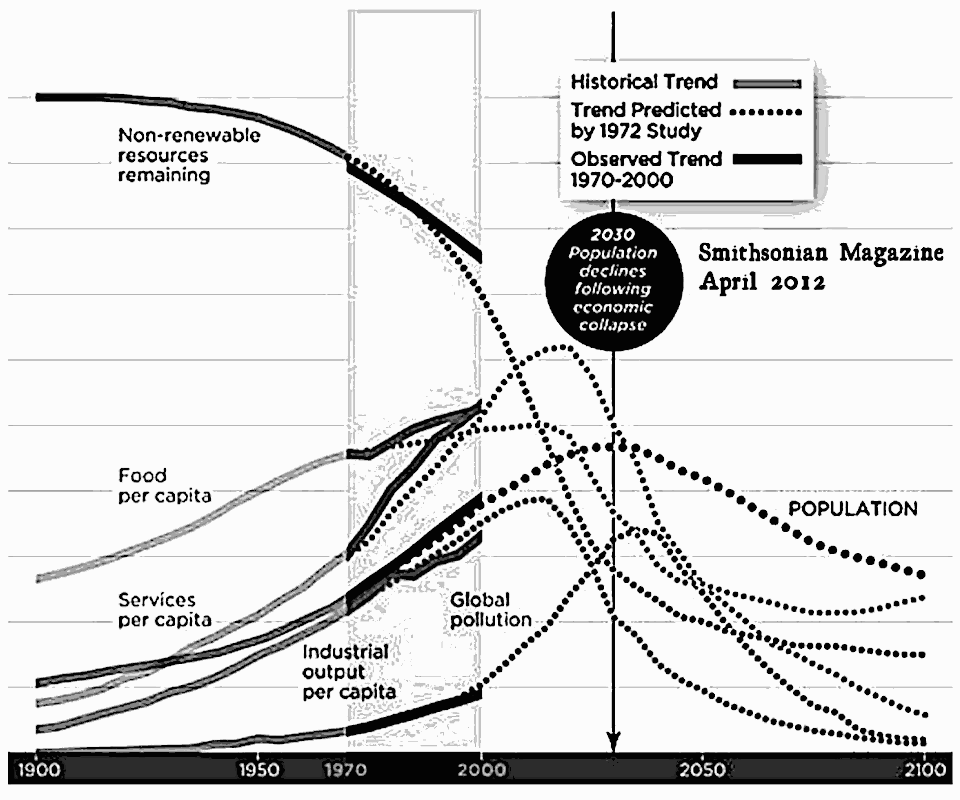
Recently a new study, Update to limits to growth – Comparing the World3 model with empirical data, was published in ‘The Journal of Industrial Ecology’ by an analyst, Gaya Herrington – who works at the US arm of international financial services firm, KPMG. Needless to say, it was the source of this new study that perhaps ruffled more feathers than the actual details of what was said.
Herrington references Turner’s work from a decade before, and seeks to check if ‘LtGs’ projections are still on track:
“The few comparisons of empirical data with the scenarios since then, most recently from 2014 (Turner), indicated that the world was still following the ‘business as usual’ (BAU) scenario… This article describes the research into whether humanity was still following BAU and whether there seemed opportunity left to change course to become more aligned with another LtG scenario, perhaps one in which collapse is avoided.”
A very jolly introduction then. Almost like it assumed the world must have changed over the previous decade. The paper also referenced the criticism LtG has received over the years:
“The LtG books & World3 received much criticism at the time. Much of this was focused on the economic and technological assumptions underlying the World3 model [and] technical criticism of World3 and the new modelling technique (system dynamics) itself. There were also misconceptions about the scenarios and LtG message, some of which have proven persistent and influential in the public debate.”
The paper shows new data, and ways of plugging that in to the LtG model. The conclusions of this study, then?:
“The data comparison, which used the latest World3 version, included four scenarios: BAU, BAU2, CT, and SW. Empirical data showed a relatively close fit for most of the variables… When scenarios had started to diverge, the ones that aligned closest with empirical data most often were BAU2 and CT… At this point therefore, the data most aligns with the CT and BAU2 scenarios which indicate a slowdown and eventual halt in growth within the next decade or so, but World3 leaves open whether the subsequent decline will constitute a collapse.”
Let’s be clear: This is not directly related to climate alone.
What Turner and Herrington are modelling is ‘everything’ – resources, population, pollution, food, and the production of goods. Climate impacts are only an incidental factor in that.
If we stray away from purely ‘LtG’-related studies, others reflect this too. In early 2021 a group of scientists published a paper in ‘The Frontiers of Conservation Science’. It had a very snappy title, ‘Underestimating the Challenges of Avoiding a Ghastly Future’. Though not modelling like LtG, what it was commenting upon is directly attributable to the effects that past LtG models have predicted:
“Humanity is causing a rapid loss of biodiversity and, with it, Earth’s ability to support complex life. But the mainstream is having difficulty grasping the magnitude of this loss, despite the steady erosion of the fabric of human civilization.”
They continue:
“Stopping biodiversity loss is nowhere close to the top of any country’s priorities… It is therefore no surprise that none of the Aichi Biodiversity Targets was met. Even had they been met, they would have still fallen short of realizing any substantive reductions in extinction rate. More broadly, most of the nature-related UN Sustainable Development Goals (SDGs) are also on track for failure.”
While there are more studies we could reference, perhaps the best is one of the most recent, ‘Through the Eye of a Needle – An Eco-Heterodox Perspective on the Renewable Energy Transition’, published by Seibart and Rees in the journal ‘Energies’ in July 2021. Looking at what it would take to solve human ‘overshoot’, their results are seemingly impossible to achieve, and attack one of the mainstream’s key ideas for that, the ‘Green New Deal’:
“The GND illusion paints a picture of ‘affordable clean energy’ that ignores innumerable costs that cannot be afforded by any reasonable measure. It suggests solutions that are impossible to deliver with current technologies, & not within the time-frame specified by the IPCC. Not only is the GND technically flawed, but it fails to situate climate disruption within the broader context of ecological overshoot.”

For those who read this research – based on real-world observation not economic assumption – the facts are getting annoyingly familiar. As Seibert & Rees outline, society is not prioritizing the overshoot & collapse of human society; and in fact, as every other preceding study should have told you by now, many are actively in denial of these facts.
For those who are willing to see the data as it is, it’s time to make a break with the ‘suicide cult’ of today’s ‘social contract’; acting to build ‘lifeboats’, the kind of community actions that WILL solve this predicament, as a direct challenge to society’s inaction. That means collaboratively learning how to ‘make’ a life outside of industrial society.
‘The problem IS affluent society’
Mainstream views of solving the ecological crisis take economic growth & industrial society as an ‘invariant factor’ in their projections. It’s time to accept that this approach does not produce rational results; we must embrace the ‘degrowth’ alternatives.
Background research:
- Nature Urban Sustainability: ‘Radical changes are needed for transformations to a good Anthropocene’, vol.1 art.5, February 2021;
- Nature Communications: ‘Renewable energy production will exacerbate mining threats to biodiversity’, vol.11 art.4174, September 2020;
- Nature Sustainability: ‘The importance of resource security for poverty eradication’, vol.4 pp.731-738, April 2021;
- Nature: ‘A safe operating space for humanity’, vol.461 pp.472-475, 24th September 2009;
- Ecological Complexity: ‘Social complexity and sustainability’, vol.3 no.2 pp.91-103, June 2006;
- Globalizations: ‘What does de-growth mean? A few points of clarification’, September 2020.
It was not our intention to write such a long and heavy WEIRD No.5. What happened in the past few months – as you can see from the dates on many of these research papers – is that there were a large number of research studies arriving close together, and in different ways they all say much the same thing: The system is collapsing and no one ‘in charge’ is listening.
It doesn’t matter if they are billionaires at business conferences, or the heads of the leading environmental campaign groups, all proposals for change today seek to keep society ‘static’ – with all its existing inequalities and injustices preserved unchallenged. It’s time to change that presumption.
That’s not just our opinion. E.g., read the paper ‘Radical changes are needed for transformations to a good Anthropocene’, published by McPhearson & co. in ‘Nature Urban Sustainability’ for a general criticism:
“The scale, pace, and intensity of human activity on the planet demands radical departures from the status quo to remain within planetary boundaries and achieve sustainability. The steering arms of society including embedded financial, legal, political, and governance systems must be radically realigned and recognize the connectivity among social, ecological, and technological domains of urban systems to deliver more just, equitable, sustainable, and resilient futures.”
“To speak of 'limits to growth' under a capitalistic market economy is as meaningless as to speak of limits of warfare under a warrior society. The moral pieties, that are voiced today by many well-meaning environmentalists, are as naive as the moral pieties of multinationals are manipulative. Capitalism can no more be 'persuaded' to limit growth than a human being can be 'persuaded' to stop breathing. Attempts to 'green' capitalism, to make it 'ecological', are doomed by the very nature of the system as a system of endless growth.”
Murray Bookchin, ‘Remaking Society’ (1990)
The tendency to ignore unwelcome news in order to preserve the lifestyle of the affluent can be seen in issues like renewable energy. As stated in the previous section, the idea that renewable energy is ‘clean’, or free of damage is wrong. As the recent paper, ‘Renewable energy production will exacerbate mining threats to biodiversity’, by Sonter & co. in ‘Nature Communications’ outlined:
“We discovered a greater proportion of pre-operational mines targeting materials needed for renewable energy production (83.9%) compared to operational mines targeting these materials (72.8%), and that pre-operational mining areas targeting the materials critical for renewables also seem more dense than those targeting other materials… Habitat loss and degradation currently threaten >80% of endangered species, while climate change directly affects 20%. While we cannot yet quantify potential habitat losses associated with future mining for renewable energies, our results illustrate that associated habitat loss could be a major issue.”
If we are in ‘overshoot’, then to a large extent we are going to have to make the systems and infrastructure we already have last longer. That is also being studied as an alternative option to lower future emissions. But as the study ‘The importance of resource security for poverty eradication’ by Wackernagel & co. in ‘Nature Sustainability’ highlighted:
“Famines and resources constraints have occurred in recent human history. It has been argued that they were caused mostly by unequal access rather than absolute, physical scarcities. However, the emergence of the Anthropocene may have shifted this dynamic. The Anthropocene is marked by unprecedented global change leading to declining global ecosystem health and rising pollution, consistent with global ecological overshoot.”
Under current global systems, surpluses are traded, and it is the inability to access this surplus production which tends to increase their chance of poverty. The prime example being biofuel production which made food prices rise, forcing many into food poverty.
What the Wackernagel study found was that as system as a whole contracts with overshoot, surpluses quickly disappear. This accelerates the growth of poverty very quickly. On their data, 72% of countries may have problems supporting their current economy as overshoot disrupts the global economy.
One paper that made waves a decade ago was Rockstrom et al.’s, ‘A safe operating space for humanity’. It argued that of seven quantified limits to human development, three were already in overshoot. The problem with that study was that people treated these boundaries as ‘static’; as fixed and knowable quantities. As the paper itself said:
“Although the planetary boundaries are described in terms of individual quantities and separate processes, the boundaries are tightly coupled. We do not have the luxury of concentrating our efforts on any one of them in isolation from the others. If one boundary is transgressed, then other boundaries are also under serious risk.”
We can’t solve them one at a time! It’s a package deal!
What this highlights is something that too few environmentalists consider when they neatly compartmentalize ‘problems’ into simple, separate issues: ‘Complexity’.
Evolution isn’t just an issue of things being well-adapted to the environment. That adaptation encourages the formation of more complex links to the world around.
Humans have taken this process one-step further: We de-centrally organize our lives, and with affluence those links involve innumerable complex links which support the consumption of goods or resources produced across the globe.
Right now the UK supply chain is falling apart, emptying supermarket shelves. That’s partly the pandemic, but in Britain that’s made worse by Brexit – and the unpredictable changes that Brexit has caused to those complex global supply chains. Now apply the idea of Brexit to ecological overshoot. It’s pretty much the same, but it never ends, and each year is potentially worse than the last.
That’s in effect the idea at the core of ‘Social complexity and sustainability’, a study by Joseph Tainter published in the journal ‘Ecological Complexity’ in 2006:
“Historical studies reveal three outcomes to long-term change in problem-solving institutions: collapse, resiliency through simplification, or continuity based on growing complexity and increasing energy subsidies. The slow development of complexity in problem solving makes its effects difficult to perceive, especially over short time periods. Long-term social sustainability depends on understanding and controlling complexity.”
To avoid chaotic collapse as those unpredictable, complex, inter-twined links are disrupted by overshoot, the only option is ‘radical simplicity’ – deliberately removing those links to simply supplying our needs.
This approach is the core of ‘degrowth’ studies – an approach that not only abandons ‘growth’, but seeks to minimize consumption to simplify those supply links and make them easier to maintain.
A good example of this is ‘What does de-growth mean? A few points of clarification’, a review by Jason Hickel in the journal ‘Globalizations’:
“Scientists and ecological economists are increasingly calling for a shift to ‘post-growth’ and ‘degrowth’ strategies… This approach is also ecologically coherent: reducing material throughput not only helps us to address climate change, but also removes pressure on other planetary boundaries.”
Degrowth is controversial precisely because of implying that growth must end. But as the study outlines, it’s the only approach which – as Rockstrom said earlier – tackles all impacts at the same time.
In some sense, Brexit is a small vision of what happens when you disrupt the systems that support the complex modern lifestyle. It should be a warning for the greater disruption to come. But many will not see it like that; and will make futile attempts to “build back better”.
We must embrace in a new relationship with the land
First the Enlightenment, and then Industrialization, separated humans spiritually and physically from the land. Recent studies find that the only certain way to reduce global impacts, and create a ecologically viable lifestyle, is to re-establish that relationship to the land and natural systems.
Background research:
- PNAS: ‘People have shaped most of terrestrial nature for at least 12,000 years’, vol.118 no.17 art.e2023483118, April 2021;
- Journal of Agricultural and Food Chemistry: ‘The Nexus of Food, Energy, and Water’, vol.65 pp.6255-6262, June 2014;
- Journal of Cleaner Production: ‘Agriculture and degrowth – State of the art and assessment of organic and biotech-based agriculture from a degrowth perspective’, vol.197 no.2 pp.1823-1839, October 2018;
- Journal of Peasant Studies: ‘Degrowth and critical agrarian studies’, vol.47 no.2 pp.235-264, 2020.
This edition of WEIRD has posed some difficult truths for us all to consider. In this penultimate section we look at research which seeks to propose an alternative: That addresses overshoot ; that degrows our economic consumption; that simplifies the complex links that support daily life; and which reduces humanity’s impact upon all those planetary boundaries.
To summarize this in three words: “Rewild the People”.

The first thing to accept is that there are few ‘natural’ landscape in the world. Humans have been transforming the landscape – first with fire, and upon discovering metals, by clearing it – for 12,000 years.
As outlined in the study by Ellis & co., ‘People have shaped most of terrestrial nature for at least 12,000 years’, from PNAS in April 2021:
“[By 2017] more than 80% of the terrestrial biosphere was transformed to varying degrees by human populations and land use, with 51% [intentisvely managed], 30% cultured, and just 19% in wildlands… In striking contrast to prior historical global reconstructions, in which wildlands covered 82% of Earth’s land in 6,000 BCE.”
This is the point made many times earlier; as the human species expands over the land, it consumes its ‘productivity’ for itself, displacing wildlife.
That process has now reached its limits, though. Not just because it is disrupting planetary boundaries, but also because the resources required to maintain that expansion, and its growing complexity, are running short.
Even the more hard-nosed journals on science and agriculture have been covering the implications of this for some time. Such as the study by Finlay & Seiber, ‘The Nexus of Food, Energy, and Water’, in the ‘Journal of Agricultural & Food Chemistry’ in 2014:
“The dilemma of food, energy, and water present us with a worldwide multidimensional problem that links resources, politics, and quality of life for all on the planet now and for the 9 billion that will inhabit the plant in the next 40 years. We must adopt a nexus approach to deal with the relationships of food, energy, and water. None of these issues can be effectively resolved in isolation.”
It’s that same message again: We have to deal with all these problems simultaneously – we can’t break them down into separate issues.
Trying to fix these problems using human technology burns yet more energy and resources, which we don’t have; and as we reach the limits of production, producing the same quantity of material requires progressively more and more energy and expense. We have to adopt a solution which doesn’t require massive human infrastructure development to create.
In short, we need to reverse the tide of human expansion, and return more land to natural systems, allowing those natural system to more efficiently function and solve these problems.
This goes beyond ‘degrowth’. Degrowth still presumes we live a technological/urban lifestyle, but with ‘less’. Instead we must look to more radical studies that not only contract the human economy, but simplify human lifestyles within the pattern of those natural planetary systems.
Such as study, ‘Agriculture and degrowth – State of the art and assessment of organic and biotech-based agriculture from a degrowth perspective’, was published by Gomierio in the ‘Journal of Cleaner Production’ in 2018:
“Degrowth supporters call for the adoption of a more frugal lifestyle, based on local production and food self-sufficiency, and of short food chains… This relies on the assumption that a country has enough agricultural land to produce all the food it needs, and sufficient internal energy and natural resources (i.e. fuel, machinery, labour) to run agricultural activities. This may not be the case for European countries. While such ideas can offer food for thought, actual research on agriculture and degrowth is much needed in order to start providing models and scenarios for public debate.
The study concludes:
“The problems we are facing, clearly and urgently call for a new model of development, and lifestyle, to be put forward and implemented. It is important to carry out deeper and comprehensive research work in order to explore the feasibility and viability of possible transition paths and scenarios… The feasibility and viability of alternative production systems should be addressed, departing from the concepts of energy efficiency and energy flow (power), and embracing a metabolic approach to the study of societal transition.”

People have been undertaking such ‘practical research’ in Britain since the 1890s (arguably since ‘The Diggers’ in the 17th Century). Different groups, at different times, have left the cities to ‘return to the land’. While many, for many reasons, failed; many persist until today. Those which persist in living a ‘low impact development’ lifestyle are not living “like everyone else”. They are, for want of a label, ‘modern peasants’.
The problem with the denial of planetary boundaries, resource depletion, and hence limits to growth, is that modern society, especially the media, plays-off feel-good ideas about ‘future innovation’ against more miserable ideas about ‘ecological lifestyles’. And in reality, if you compare that false techno-optimistic view of the world, with a rather badly demonstrated idea of labouring on the land to grow your own food, most people are not going to settle for the lower impact alternative.
We would argue that we have to go beyond Gomiero’s call for ‘studies’. People have to see examples of ‘ordinary’ people living a sufficient, comfortable lifestyle in low impact developments. Only then, if they can actually see it, might they have the confidence to also see through the delusion of endless economic growth, and make a commitment to positive change. Un-fortunately the people already living this lifestyle tend not to promote their work; in part because their daily lives are tied-up actually living that life.
Julien-François Gerber, an Assistant Professor at the International Institute of Social Studies in The Hague, has proposed such a positive exploration of, what he terms, “agrarian studies”. Published in the (perhaps aptly named) ‘Journal of Peasant Studies’ in 2020, his article, ‘Degrowth and critical agrarian studies’, is a wealth of ideas, too long to easily summarize here.
As stated in the abstract:
“Degrowth posits that such a transition is indispensable but also desirable. However, the conditions of its realization require more research. This article argues that ‘critical agrarian studies’ (CAS) and degrowth can enrich each other. The Agrarian Question and the Growth Question should be addressed in concert. While degrowth should not fall into the ‘agrarian myth’, CAS should not embrace the ‘myth of growth’, even when green and socialist.”
Gerber looks at how Western philosophy considers the tension between the ‘natural’ and ‘progress’. While a few consider elements of the solution, none really has escaped their ‘urban’ perspective. In contrast developing world economies, like Bhutan, have sought to modify Western development values, to protect the valued parts of their own traditional lifestyle; from which we could learn. He concludes:
Van Paasen interjected,“You will be sitting on a pile of ruins.”
Durruti replied,“We have always lived in slums and holes in the wall. We will know how to accommodate ourselves for a time. For, you must not forget, we can also build. It is we the workers who built these palaces and cities here in Spain and in America and everywhere. We, the workers, can build others to take their place. And better ones! We are not in the least afraid of ruins. We are going to inherit the earth; there is not the slightest doubt about that. The bourgeoisie might blast and ruin its own world before it leaves the stage of history. We carry a new world here, in our hearts. That world is growing this minute.”
Buenaventura Durruti, interviewed by Pierre van Paasen (1936)
“One should distinguish between a myth as a false idea and a myth as a conveyor of symbolic meanings. Even if the agrarian myth and the myth of growth are factually untenable, they may nonetheless both symbolize very real needs to resist the alienating tendencies of capitalist modernity. The agrarian myth is a tale of lost harmony with one another and with nature, while the myth of growth could be seen as a compensation for the impossibility to ‘express our lives’… the Left should take these two myths seriously, as an unconscious expression of distress, and help people see where and how these fundamental needs can be actualized in the real world. Degrowth could be a direction of choice for that.”
Just as liberal ‘reforming’ environmentalists – described by Bill Devall – seek an unrealistic compromise with affluent lifestyles, so those on the ‘radical’ left equally deceive themselves – believing you only need remove ‘the elite’ to create a good world for all… albeit one still in ecological overshoot!
It may be an unwelcome fact, but the core of having ‘less’ is based on secure food and shelter. That issue is essentially ‘agrarian’, not industrial/technolgical. The solutions, then, must exist within a degrowth that ‘rewilds’ us within nature – living from the land.
Numerical Ramblings – ‘The zombie pro-nuclear lobby’
Why do the advocates of nuclear power refuse to die, or at least see statistical reason?
It was a predictable statement from a pro-nuclear type. In an on-line tussle with pro-nuclear ‘eco-modernist’ Mark Lynas, someone else waded in.
In this edition of WEIRD, the focus has been on the evidence for a wider ecological collapse – and why many ‘clever’ people in society, even most environmentalists, just don’t see it. If you want a model for what will happen when that does materialize, and the kind of opposition that will deny this is happening to the last, look no further than the affluent, quasi-religeous ‘scientism’ of the pro-nuclear lobby:
“Uranium contains 78 tera-Joules of power per kilo?”
That statement is so wrong! A reply unpacking the numbers into a more objective statistical reality was required:
The question, ‘how much energy does uranium contain’, is complicated. This is why the nuclear industry has been able to lie about it for so long, and people have let that lie pass unchallenged.
Let’s start with uranium metal. Uranium contains two isotopes (atomic forms): One, U-238, makes up 99.3% of all natural uranium; the other U-235, is the other 0.7%. Put natural uranium in a fast-fission reactor and you may get 86 tera-Joules (TJ) of heat energy from it.
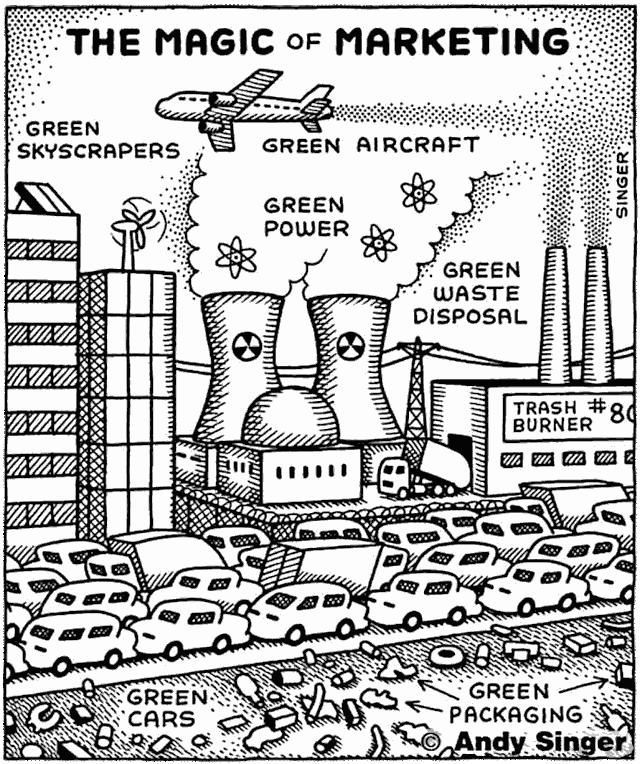
The problem for the industry is that they haven’t yet perfected a commercial fast reactor. Nearly all the reactors working today are thermal-fission reactors, which only run on U-235 – meaning 99.3% of that kilo of uranium metal is pretty much useless (albeit a minute quantity will be transformed into plutonium, which adds a very small amount of energy to the process).
To use U-235 it has to be enriched, raising the level from 0.7% to 3.5% U-235 per kilo. That means to make 1 kilo of nuclear fuel, you need [3.5÷0.7=] 5 kilos of uranium metal and a lot of energy (we’ll come back to that).
A kilo of enriched uranium goes into the reactor. The U-235 is split, releasing heat. U-235 has a high energy density, 79.4TJ/kg, but it is only 3.5% of the fuel. So the fuel releases [3.5×79.4=] 2.8TJ/kg as heat energy.
That energy is collected as heat and turned it into electrical power. Nuclear stations work in the same was as any thermal power station: Boiling water to make steam, that spin generators to make power. Modern coal plants can be 40% efficient. The problem with nuclear plants is that all the extra equipment they demand itself requires electricity to function. That lowers the efficiency. A nuclear plant may only be 30% to 35% efficient. At 33% efficiency, that 2.8TJ of heat from the fuel will generate 0.92TJ of electrical power.
Revisiting the original statement, divide the amount of uranium before enrichment, 5kg, by the amount of electrical power, 0.92TJ, gives a ‘power density’ of [0.92÷5=] 0.18 tera-Joules per kilo – 433 times less than the original statement.
However, even that figure is not truly accurate. With conventional plants the fuel is simply mined, burned, and the toxic gases dump into the environment. That doesn’t happen with the nuclear fuel cycle – for obvious reasons. The problem is there’s great uncertainty about the data, in part because the industry doesn’t want to co-operate in destroying their own case.
A 1 giga-Watt nuclear reactor needs perhaps 27 to 30 tonnes of nuclear fuel per year. At 3.5% enrichment, that’s 140-odd tonnes of uranium metal.
The problem today is that the best, highest quality sources of uranium are running out – just like oil, or copper, or the many other industrial resources technological society depends upon. Pro-nuclear people like to talk about the cost, or the tonnage of uranium remaining. What is far more important is the ore quality of the uranium deposit.
Gone are the days of ores with 1% uranium. The richest mines today are working at 0.5% to 0.1% uranium. At 0.5% each tonne of uranium needs 200 tonnes of rock; at 0.1% it’s 1,000 tonnes of rock. To supply a 1GW reactor with fuel for a year takes perhaps 28,000 to 140,000 tonnes of rock.
As the ore quality drops steadily the rock required, and the energy to process it, increases exponentially. At 0.05% quality – still considered a viable deposit – it takes a quarter of a million tonnes of rock to fuel a 1GW reactor for one year. That’s almost a million tonnes a year for the new 3.2GW Hinkley C plant.
This is what’s known as the ‘energy cliff’: The lower the resource quality, the exponentially lower the energy return; and soon more energy is used to make the fuel than is generated by its use.
At what point the energy put into the process exceeds the energy from the reactor is not clear – again, due to the lack of data on these processes. It has been theoretically calculated that when the ore quality falls to 0.01% the energy return drops to zero; for hard rock sources it could be before that point.
If you think that’s entertaining, let’s return to the original argument with Mark Lynas: When it comes to nuclear, he is a true ‘Cornucopian’ believer. He does not believe there are any practical limits to nuclear power because we can extract uranium from seawater. No, seriously, that’s their future fall-back uranium supply. It’s a ‘talking point’ the industry throw onto the table like a dead cat to distract people from looking at the details of world uranium resources.
Those who want to make change should study the pro-nuclear lobby, and how they work, very carefully. The nuclear industry took the ‘tobacco industry playbook’ and put it on steroids.
Due to their unswayable faith in ‘innovation’ and technology, pro-nuclear activists represent, in microcosm, the kind of people who – irrespective of real-world events – will refuse to believe that their beloved era of ‘progress’ is coming to an end. As ‘true believers’ in industrial society, we should study their ideological intransigence, to find a way to subvert it, and hence that wider faith in affluence and progress that is killing the ecosphere.
W.E.I.R.D.: THINKING BEYOND TECHNOLOGY – No.5, Mabon 2021
A Free Range Activism Network Publication. Download other editions of ‘WEIRD’ at http://www.fraw.org.uk/frn/weird/index.shtml. Email any comments or feedback to weird☮frăwꞏörĝꞏuk. Issued under Creative Commons BY-NC-SA-4 license; you may freely distribute.