‘WEIRD’, A Free Range Journal – Issue No.6, Yule 2021:
The Ecological ‘Lie of the Land’
An edition for the long dark nights on why a radical change to property rights in Britain is essential to changing our global impact – looking at UK ‘land rights’ in the context of the ecological crisis, not simply land ownership.
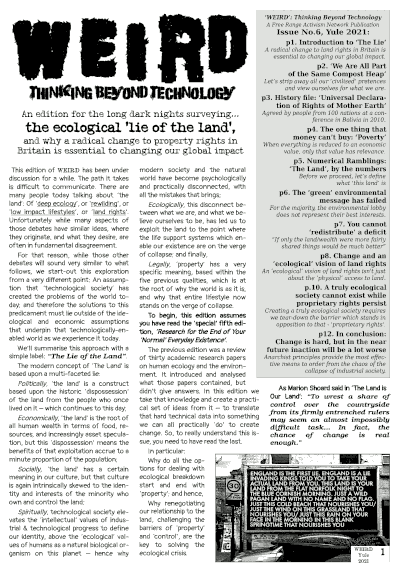
Download this edition
1A4 PDF – for printing at A4 single- or double-sided; or
2A3 PDF – for printing landscape A3 double-sided to create a folded/stapled brochure.
‘WEIRD’ is designed to print at A4, but will reduce to A5 and be about the same size as small newsprint. The A3 PDF will scale for double-sided A4 landscape
Issue No.6 Contents:
- Introduction – The ecological ‘lie of the land’
- A radical change to land rights in Britain is essential to changing our global impact.
- ‘We Are All Part of the Same Compost Heap’
- Let’s strip away all our ‘civilized’ pretences and view ourselves for what we are.
- History file – ‘Universal Declaration of Rights of Mother Earth’
- Agreed by people from 100 nations at a conference in Bolivia in 2010.
- The one thing that money can’t buy: ‘Poverty’
- When everything is reduced to an economic value, only that abstract value has relevance to political debate – which is what excludes most people from politics.
- Numerical Ramblings – ‘The Land’, by the numbers
- Before we proceed, let’s define what ‘this land’ is.
- The ‘green’ environmental message has failed
- For the majority, the environmental lobby does not represent their best interests for a survivable future.
- You cannot ‘redistribute’ a deficit
- A ‘shallow view’ of the land issue says, “if only the land/wealth were more fairly shared things would be so much better”; neglecting to point out that the major cause of global ecological damage is that there is too much ‘wealth’ already.
- Change and an ‘ecological’ vision of land rights
- An ‘ecological’ vision of land rights isn’t just about the ‘physical’ access to land; it’s as much about what defines ‘property’ and ‘commonality’, both between humans, but more importantly, between all species on Earth – and why present-day politics and economics just can’t see that reality.
- A truly ecological society cannot exist while proprietary rights persist
- If ecological thinking, or calls for greater or more equitable land rights, failed, then it is not because they are ‘unreasonable’; it is because they have been far too reasonable in their call for change. Creating a truly ecological society requires we tear-down the barrier which stands in opposition to that – ‘proprietary rights’.
- In conclusion – Change is hard, but in the near future inaction will be a lot worse
- Anarchist principles provide the most effective means to order from the chaos of the collapse of industrial society.
Introduction – The ecological ‘lie of the land’
A radical change to land rights in Britain is essential to changing our global impact.
This edition of WEIRD has been under discussion for a while. The path it takes is difficult to communicate. There are many people today talking about ‘the land’: Of ‘deep ecology’, or ‘rewilding’, or ‘low impact lifestyles’, or ‘land rights’. Unfortunately while many aspects of those debates have similar ideas, where they originate, and what they desire, are often in fundamental disagreement.
For that reason, while those other debates will sound very similar to what follows, we start-out this exploration from a very different point: An assumption that ‘technological society’ has created the problems of the world today; and therefore the solutions to this predicament must lie outside of the ideological and economic assumptions that underpin that technologically-enabled world as we experience it today.
We’ll summarize this approach with a simple label: “The Lie of the Land”.
The modern concept of ‘The Land’ is based upon a multi-faceted lie:
Politically, ‘the land’ is a construct based upon the historic ‘dispossession’ of the land from the people who once lived on it – which continues to this day;
Economically, ‘the land’ is the root of all human wealth in terms of food, resources, and increasingly asset speculation, but this ‘dispossession’ means the benefits of that exploitation accrue to a minute proportion of the population;
Socially, ‘the land’ has a certain meaning in our culture, but that culture is again intrinsically skewed to the identity and interests of the minority who own and control the land;
Spiritually, technological society elevates the ‘intellectual’ values of industrial & technological progress to define our identity, above the ‘ecological’ values of humans as a natural biological organism on this planet – hence why modern society and the natural world have become psychologically and practically disconnected, with all the mistakes that brings;
Ecologically, this disconnect between what we are, and what we believe ourselves to be, has led us to exploit the land to the point where the life support systems which enable our existence are on the verge of collapse; and finally,
Legally, ‘property’ has a very specific meaning, based within the five previous qualities, which is at the root of why the world is as it is, and why that entire lifestyle now stands on the verge of collapse.
To begin, this edition assumes you have read the ‘special’ fifth edition, ‘Research for the End of Your ‘Normal’ Everyday Existence’.
The previous edition was a review of thirty academic research papers on human ecology and the environment. It introduced and analysed what those papers contained, but didn’t give answers. In this edition we take that knowledge and create a practical set of ideas from it – to translate that hard technical data into something we can all practically ‘do’ to create change. So, to really understand this issue, you need to have read the last.
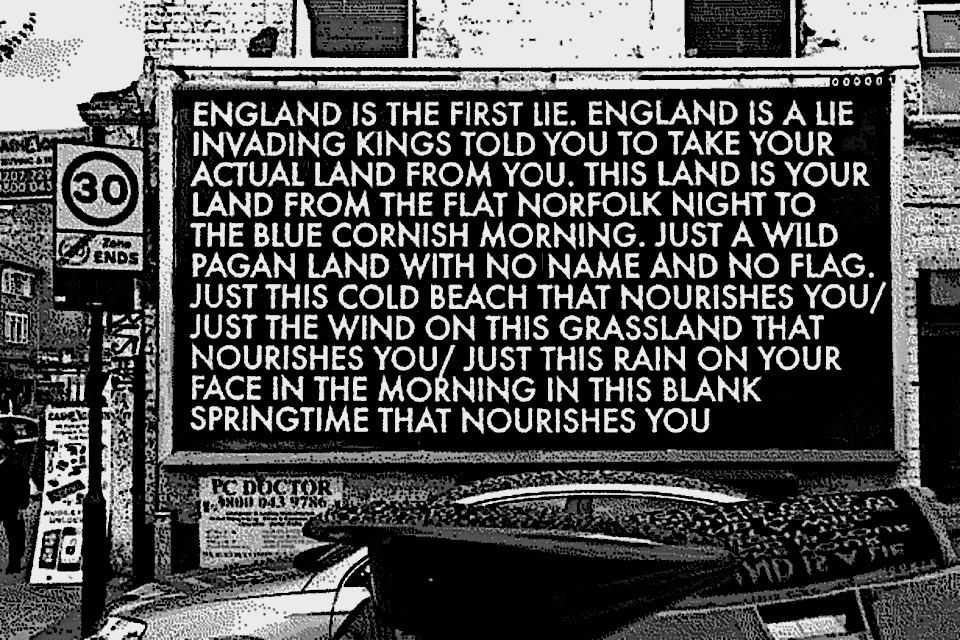
In particular:
- Why do all the options for dealing with ecological breakdown start and end with ‘property’; and hence,
- Why renegotiating our relationship to the land, challenging the barriers of ‘property’ and ‘control’, are the key to solving the ecological crisis.
As Marion Shoard said in ‘This Land is Our Land’: “To wrest a share of control over the countryside from its firmly entrenched rulers may seem an almost impossibly difficult task... In fact, the chance of change is real enough.”
‘We Are All Part of the Same Compost Heap’
Let’s strip away all our ‘civilized’ pretences and view ourselves for what we are.
The ‘climate crisis’ doesn’t mean the same thing for all. How we each relate to “the global crisis” is defined by our relation to the technological system, and our own role in that system.
The developed world’s conceit is that it will produce some ‘magick’ technological cure for the climate change; but in truth this must one day lead to a painful realization: “Superman’s not coming!” That realization will not truly hit until the most affluent within industrialized states have their daily lives disrupted by these events.
As Vandana Shiva observed years ago, today we see ‘Third World’ scenes in the cities of many affluent industrial states. As the global system cannibalizes the infrastructure of the most advanced societies to keep running growing inequality is already creating very different personal impacts – from food banks to potholes in the road; but these ‘new’ trends represent the re-emergence of the historic social divides that existed before the 1930s.
However you describe the different effects across the world, the coming ecological collapse of technological society embodies a simple fact: Be it climate change or the depletion of resources, this coming crisis will result in a far greater level of ‘fall’ in living standards for the most affluent compared to the least affluent.
“We all have a tendency to think that the world must conform to our prejudices. The opposite view involves some effort of thought, and most people would die sooner than think – in fact they do so.”
Bertrand Russell, ‘The ABC of Relativity’ (1925)
Yes, if you’re poor, your life will be harder and even less predictable. But for the affluent, their probable level of contraction in material lifestyle is beyond their life experience: It’s quite literally ‘unimaginable’ for them.
Now, if you’re one of those who live in advanced technological society – with 24/7 electricity, piped clean water, and fresh underwear every morning – what in your possible daily experience has prepared you to deal with that eventuality? And if you’re one of the poorest in those societies, how bad do you think it will get for you?
How we see society, both its normal operation and its great catastrophes, has been shaped by our cultural, political and social history. That baggage is not free of historic inequality. It has been created from the point-of-view of the most affluent; the people who are the last to be badly affected by any crisis. Their innate ‘security’ has always made radical change a difficult subject to discuss.
As we explored in the previous edition of WEIRD, when academics look at the ecological impacts of modern society, despite the environmental debate being dominated by arguments over efficiency and technology, evidence shows it is consumption and affluence which drive global destruction – and so limiting consumption is the only means to effectively curb ecological damage. For example:
According to a 2021 study by the International Energy Agency (IEA), energy use across society fell during the pandemic, except for SUVs. The rise in new SUVs sales during 2020 led to more oil consumption; and in fact, it cancelled out the carbon savings from the sale of all new electric cars in that year.
UK transport minister Rachel Maclean recently argued people must keep flying, or airlines wouldn’t buy more efficient planes. According to recent data, 70% of all flights are taken by only 15% of passengers; half the population never fly at all; and globally 1% of people cause more than half of all aviation impacts.
Insulate Britain seem to be very concerned that homes should be insulated. Rarely, it seems, do they discuss the fact that the most affluent 10% of homes consume two or three times the amount of energy of the poorest 10% of homes.
If there are so few people doing most of the flying, or SUVs cause far worse pollution than other cars, why does the government not take action to stop them? Put simply, these things benefit the most affluent; and it is the most affluent 5% of society (those earning £80,000/year and above) for whom government policy is written.
“Environmentalism without class struggle is gardening”
Chico Mendes, quoted in ‘Full Circle: Power, Hope and the Return of Nature’ (2021)
If we strip away the polite etiquette environmentalism promotes, and focus only on what the data says, we come to a very different understanding of what ‘the crisis’ is; and how we might start to tackle it. The fact these ideas are not considered ‘politically acceptable’ has nothing to do with that reality. It is simply that the affluent 5% who dominate the debate in politics, economics, and the media, consciously or unconsciously, censor any discussion which is critical of that lifestyle.
In each article we’ll highlight some basic principles, which we’ll revisit in the conclusion:
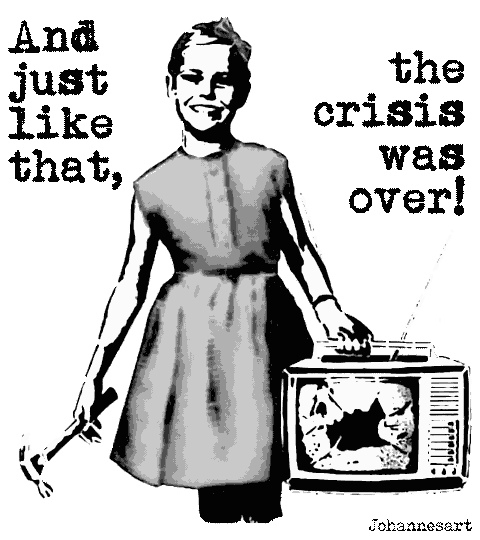
THE FIRST NECESSARY REALIZATION: Meaningful change can only happen when we ignore historic or popular assumptions, and focus on real-world evidence – however disturbing or difficult that might be.
There is a general assumption that radical change is not possible because people “won’t do it”. The flaw in this reasoning is that it assumes the coming ecological crisis is ‘voluntary’. Hence it exposes ‘the lie’ of contemporary environmentalism: Their priority is the maintenance of the affluent, entitled lifestyle, rather than promoting radical action that will ‘save the planet’ – irrespective of the impacts on the wealthy minority.
History file – ‘Universal Declaration of Rights of Mother Earth’
Rather than define the problem in terms of resources and maintaining consumption, the declaration sought to define the priority as respecting the Earth as a single living organism – with all natural living ecosystems having a right of existence over and above the right of a minority of the human species to consume resources and destroy the environment.
While the UN General Assembly has not formally acknowledged the declaration, it has been presented to the UN General Assembly by a number of global campaigns for adoption.
In the wake successive failures by industrial nations to agree meaningful change, and to accept the folly of continued economic growth, the ‘Declaration of the Rights of Mother Earth’ represents the only widely-supported alternative agenda for global change which seeks to move the ecological debate beyond petty national squabbles over materialism.
Universal Declaration of Rights of Mother Earth
Agreed by people from 100 nations at a conference in Bolivia, 22nd April 2010. World People’s Conference on Climate Change & the Rights of Mother Earth, Cochabamba, Bolivia
Preamble
We, the peoples and nations of Earth:
considering that we are all part of Mother Earth, an indivisible, living community of interrelated and interdependent beings with a common destiny;
gratefully acknowledging that Mother Earth is the source of life, nourishment and learning and provides everything we need to live well;
recognizing that the capitalist system and all forms of depredation, exploitation, abuse and contamination have caused great destruction, degradation and disruption of Mother Earth, putting life as we know it today at risk through phenomena such as climate change;
convinced that in an interdependent living community it is not possible to recognize the rights of only human beings without causing an imbalance within Mother Earth;
affirming that to guarantee human rights it is necessary to recognize and defend the rights of Mother Earth and all beings in her and that there are existing cultures, practices and laws that do so;
conscious of the urgency of taking decisive, collective action to transform structures and systems that cause climate change and other threats to Mother Earth;
proclaim this Universal Declaration of the Rights of Mother Earth, and call on the General Assembly of the United Nation to adopt it, as a common standard of achievement for all peoples and all nations of the world, and to the end that every individual and institution takes responsibility for promoting through teaching, education, and consciousness raising, respect for the rights recognized in this Declaration and ensure through prompt and progressive measures and mechanisms, national and international, their universal and effective recognition and observance among all peoples and States in the world.
Article 1. Mother Earth
- Mother Earth is a living being.
- Mother Earth is a unique, indivisible, self-regulating community of interrelated beings that sustains, contains and reproduces all beings.
- Each being is defined by its relationships as an integral part of Mother Earth.
- The inherent rights of Mother Earth are inalienable in that they arise from the same source as existence.
- Mother Earth and all beings are entitled to all the inherent rights recognized in this Declaration without distinction of any kind, such as may be made between organic and inorganic beings, species, origin, use to human beings, or any other status.
- Just as human beings have human rights, all other beings also have rights which are specific to their species or kind and appropriate for their role and function within the communities within which they exist.
- The rights of each being are limited by the rights of other beings and any conflict between their rights must be resolved in a way that maintains the integrity, balance and health of Mother Earth.
Article 2. Inherent
Rights of Mother Earth
- Mother Earth and all beings of which she is composed have the following inherent rights:
- the right to life and to exist;
- the right to be respected;
- the right to regenerate its bio-capacity and to continue its vital cycles and processes free from human disruptions;
- the right to maintain its identity and integrity as a distinct, self-regulating and interrelated being;
- the right to water as a source of life;
- the right to clean air;
- the right to integral health;
- the right to be free from contamination, pollution and toxic or radioactive waste;
- the right to not have its genetic structure modified or disrupted in a manner that threatens its integrity or vital and healthy functioning;
- the right to full and prompt restoration for violation of the rights recognized in this Declaration caused by human activities;
- Each being has the right to a place and to play its role in Mother Earth for her harmonious functioning.
- Every being has the right to well-being and to live free from torture or cruel treatment by human beings.
Article 3. Obligations of human beings to Mother Earth
- Every human being is responsible for respecting and living in harmony with Mother Earth.
- Human beings, all States, and all public and private institutions must:
- act in accordance with the rights and obligations recognized in this Declaration;
- recognize and promote the full implementation and enforcement of the rights and obligations recognized in this Declaration;
- promote and participate in learning, analysis, interpretation and communication about how to live in harmony with Mother Earth in accordance with this Declaration;
- ensure that the pursuit of human well-being contributes to the well-being of Mother Earth, now and in the future;
- establish and apply effective norms and laws for the defence, protection and conservation of the rights of Mother Earth;
- respect, protect, conserve and where necessary, restore the integrity, of the vital ecological cycles, processes and balances of Mother Earth;
- guarantee that the damages caused by human violations of the inherent rights recognized in this Declaration are rectified and that those responsible are held accountable for restoring the integrity and health of Mother Earth;
- empower human beings and institutions to defend the rights of Mother Earth and of all beings;
- establish precautionary and restrictive measures to prevent human activities from causing species extinction, the destruction of ecosystems or the disruption of ecological cycles;
- guarantee peace and eliminate nuclear, chemical and biological weapons;
- promote and support practices of respect for Mother Earth and all beings, in accordance with their own cultures, traditions and customs;
- promote economic systems that are in harmony with Mother Earth and in accordance with the rights recognized in this Declaration.
Article 4. Definitions
- The term “being” includes ecosystems, natural communities, species and all other natural entities which exist as part of Mother Earth.
- Nothing in this Declaration restricts the recognition of other inherent rights of all beings or specified beings.
END
The one thing that money can’t buy: ‘Poverty’
When everything is reduced to an economic value, only that abstract value has relevance to political debate – which is what excludes most people from politics.
As philosopher Mark Fisher said, “people are more willing to think about the end of the world than the end of ‘capitalism’”. Think about that: How many ideas have you heard for the end of the world?; and how many things which would make capitalism collapse.
The fact is, one will directly cause the collapse of the other – both cannot exist together indefinitely.
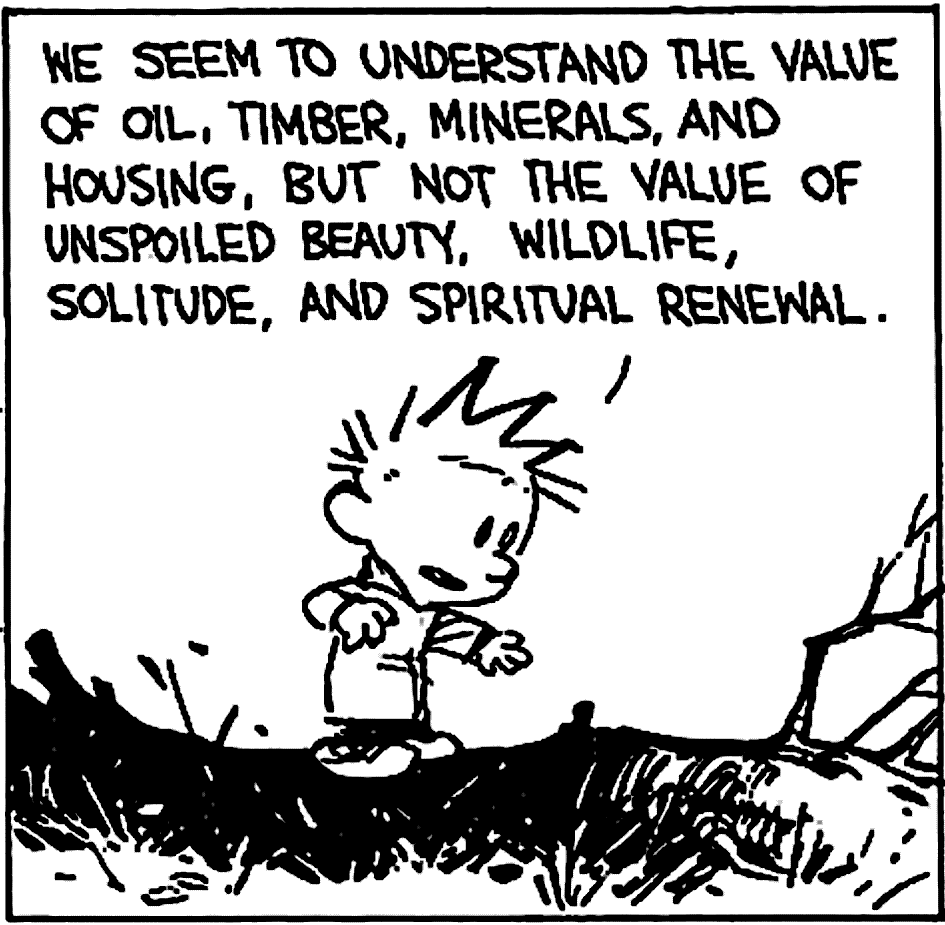
The economic values that obstruct change today do not reflect specific problems or benefits of the ‘thing’ they describe. Instead they represent ‘proprietary rights’: The ability of a person, corporation, or country, to use a resource, an idea, or a pollution discharge; and converting that ‘right of use’ it into an economic value (‘cash’), or borrowing some value against it (‘debt’).
The nature of ‘the thing’ that valuation describes has little relevance to how politicians discuss change. They seek to maximize or maintain these abstract values by protecting these ‘proprietary rights’. Breaking that willing objectification of everyday life is the key to breaking that system of control.
Now flip that: What about people whose only ‘right’ is their ability to work? They have next to no property; and for many, they can take little debt against their ‘value to work’ because it is worth so little compared to other things. Likewise, the expropriation of their earnings by the costs of this modern lifestyle mean they are unlikely – excepting lottery wins or inheritance – to accumulate any real wealth to change their relative position.
When we think of why politics is increasingly disengaged from the public: Is it that lobbyists for corporations or economic interests dominate the political agenda?; or is it that the public don’t have what politician’s want or care about? – such as the asset-based wealth.
‘Democracy’ is a danger to the excess wealth of a small section of society. That’s because, in a truly democratic society, the mass of people might vote to stop it. Since modern democratic states arose at the end of the Eighteenth Century, the reality is that a wealthy elite have sought to restrict the ability of ‘ordinary’ people to control their actions via the political process. Firstly, by ensuring only the affluent could vote; then, when that failed, using their economic influence to ensure that only certain political ideas, and only certain politicians, could ever succeed in the national political and media system.
“You cannot buy the revolution. You cannot make the revolution. You can only be the revolution. It is in your spirit, or it is nowhere.”
Ursula K. Le Guin, ‘The Dispossessed’ (1974)
If voting really could change the world, they’d ban it (or they’d just declare the election was ‘stolen’).
This is the key stumbling block that many do not recognize: What obstructs political change is not the minute details of reducing carbon emissions, or addressing poverty; what obstructs change are the efforts of politicians and the economic lobbies to ensure that as part of any reform, those historic economic ‘property rights’ are preserved.
Why did COP26 fail? The affluent industrial nations attending were not willing to put their lifestyle on the table to get an agreement. It follows, then, the only way to create change – to reduce emissions or improve the lives of the poor – is to challenge those economic rights.
Right now democracy is ‘failing’: Not because people are unwilling to defend their political rights; but because the economic elite no longer find the democratic settlement of the last 80 years to be ‘profitable’.
Via technology, especially Internet platforms, from privacy to employment rights our lives are being subsumed by a new ‘digital feudalism’ – where billionaires and their political minions create new, more exploitative economic structures outside of the control of the democratic societies. That entire system, though, is still based within legally-defined proprietary rights made by ‘friendly’ state-based legal jurisdictions. That aspect has remained unchanged since the early beginnings of modern capitalism almost five hundred years ago.
The idea of ‘liberty’ arose in Athens 2,400 years ago. Specifically, Aristotle describes ‘liberty’ as being the opposite of slavery – most simply, as having ‘no master’. As today, that meant having physical, income-generating assets to create economic freedom from the need to work for someone else.
E.g, the furore over (chair of the World Economic Forum) Klaus Schwab’s comment – that, “in 2030, you will own nothing and you will be happy about it” – can be read very differently. It’s not that you will ‘own nothing’; you’ll rent or lease the things in your life from their creators on a temporary basis, as and when you need them. Make no mistake though; that’s effectively ‘indentured servitude’ for the majority of the population. Yes, you will still have ‘choice’, but only from the options offered to you by that neo-feudal network of billionaire service providers.
Why, then, does the United Nations General Assembly not want to implement ‘The Universal Declaration of Rights of Mother Earth’?
It’s because once universal ‘legal rights’ – requiring all living beings be respected and not exploited – are conferred on humans and living ecosystems too, that 500-year-old system of proprietary rights ends. The same goes for any effective solution to climate change, ecocide laws, or better and legally enforceable standards on world trade. It negates the legal and contractual rights that define ‘property’.
“Concepts... do not merely reflect the eternal form of a legislating subject, but are defined by a communicable force in relation to their subject. They do not reflect upon the world but are immersed in a changing state of things. A concept is a brick. It can be used to build the courthouse of reason. Or it can be thrown through the window.”
All property-based economic rights are ‘concepts’; they are just ideas, or traditions, that required a state or legal authority to define an exclusive right to ‘something’. They need laws and courts to have any force; although these days these ‘courts’ are often being privatized via secret trade dispute tribunals, established via the World Bank and various international trade treaties.
THE SECOND NECESSARY REALIZATION: If there is a way out of our entrapment in this economic prison, as far as you possibly can, you can only refuse take part in it!
True ‘choice’ only exists when you have the option of refusal; when you are free to ‘do it yourself’. By disengaging from the technological system which mediates the modern lifestyle, you can live without the ‘terms and conditions’ which that system demands. There is, though, one absolute necessity to enable that option – access to land to produce food, fuel, and shelter.
That’s where the critical point of conflict between ordinary people, and proprietary rights exists: As ‘natural’ beings, once we secure food and shelter, everything else is ‘negotiable’. The greatest priority to create an ecologically viable lifestyle, then, must be to confront the economic rights that relate to land; to break that monopoly control over the most critical resource we need for all life to exist.
Numerical Ramblings – ‘The Land’, by the numbers
Before we proceed, let’s define what ‘this land’ is.
‘Britain’ is the 78th largest country in the world, with an area of ~248,500 square kilometres; and the 21st largest by population, ~67 million; making it the 52nd most densely populated in the world.
On average we get an area of 3,600 square metres, or about 9/10ths of an acre, each. But while two-thirds of the population own ‘an interest’ in land, most of the land area is owned by less than 1%.
In law, ‘bodies corporate’ have the same land ownership rights as ‘natural persons’. On various estimates about 25,000 ‘bodies’ (corporate or natural) own half the land area of Britain. Taking that as ‘people’, 0.04% own ~50%.
Of the whole area of Britain: About a third is still owned by the descendants of the landed gentry; about a fifth by corporations; another fifth by investors and speculators; less than a tenth by government; and one twentieth by ‘householders’. Most of the rest does not have clear ownership.
Just under a tenth of Britain is ‘built upon’. Of that built-on area: Half (5% of the total area) is covered by roads and transport infrastructure; one-eighth (1.1% of the total) is housing; one-twentieth by commercial and industrial uses. The rest is community infrastructure or not identified, but 0.2% are used for minerals extraction or waste disposal.
Of the 90% that is not built-on: Two-thirds are used for agriculture; a fifth are forests or lakes and reservoirs; one-twentieth are residential gardens; and another twentieth are ‘outdoor recreation’ (mostly golf courses).
A tenth of the total land area is subject to 1-in-100 year river or coastal flooding events. At least 5% to 10% may be lost to sea level rise in the next century or two.
THE THIRD NECESSARY REALIZATION: Britain is not being ‘built-over’, it is being consumed by agricultural interests operated by a small landed elite.
The ‘green’ environmental message has failed
For the majority, the environmental lobby does not represent their best interests for a survivable future.
Take the familiar messages of mainstream/‘bright green’, environmentalism. Now put yourself in the position of someone living insecurely: Such as living in a precarious housing state (as over half a million in Britain do); or having to use a foodbank (as in excess of 2 million people do). How many of those ‘green’ ideas could you practically enact?

In reality, next to none. Mostly because people in this situation do not have ‘free choice’ as consumers.
The fact is, to enact the modern ‘green’ message you must be a consumer first, and a ‘natural being’ second. More than that; you must aspire to the middle class’ conception of what constitutes a consumer lifestyle.
This is no accident. It was a decision informally taken by the (predominantly upper middle class) leaders of the UK environment movement at the end of the 1980s (see WEIRD No.2 article 4 for details).
Environmentalism is today expressed in the language of progress, management, economics, and technology – ideas which exclude any discussion which seeks to challenge ‘modernity’, and its role in defining our relationship to the natural world. But within that lays the seeds of its own failure.
As started previously, there is a fundamental conflict between economic property rights and the maintenance of a liveable planet. By glossing over that contradiction, and trying to speak the political message of the dominant economic elite, environmentalism sabotages its own efforts. Let’s put it another way: ‘Green’ ecological messages tell us that we are facing “extinction”; that our way of life is threatened with “annihilation”; yet its solutions to this catastrophe are electric cars, building more wind turbines, and banning single-use plastics.
There is a fundamental disconnect between the substance of the ‘green’ message and what it proposes. It’s solutions do not appear to square with most ‘average’ people’s estimations of the problems in the world today. In part, that’s because study-after-study has found environmentalists to be more white, more middle class, and more affluent than average.
Note: This doesn’t invalidate ‘the message’. The problem is the ‘higher ups’ in the movement are compromised by past policy decisions, and their own current social status, in the delivery of this more critical message.
In WEIRD No.5 we included extracts from Bill Devall’s paper on ‘The Deep Ecology Movement’; to contrast the environmental movement in the 1960s and 1970s, from what it had become by the 1990s, and is today. It is a movement focussed on the perpetuation of consumerism, because it no longer has a radical basis which questions – above all – the ‘needs’ versus the ‘wants’ of all humanity. Without that, it seeks to reform the economic machine rather than radically overhaul it.
Perhaps the greatest effect of this failure is not so much physical, it is spiritual. In neglecting to question our relationship to the Earth, and instead trying to manage our relationship to consumer society, environmentalism has lost the essence of ourselves as ‘natural beings’; and with that it fails to communicate with peoples deeper sense of unease about the world today.
“Environmental problems have become the psychopathology of our everyday life. The anguish of what I will call the ‘ecological unconscious’ has emerged as a deeper imbalance. If psychosis is the attempt to live a lie, our psychosis is the lie of believing we have no ethical obligation to our planetary home.”
Increasingly the stress created by the day-to-day ‘modern’ lifestyle is making us ill. From working conditions in the gig economy, to the psychological effects of social media, people are being pressured to act or consume in certain ways – and amongst a growing number that manifests as both mental and physical illness. It’s not just that those who do not have the economic ability to attain that consuming life feel alienated; people who have those things are left seemingly unsatisfied by them too.
The response of the movement has been to try and use better facts, or to be more rational, in order to make better arguments to governments. But as COP26 showed, governments, and the lobbying interests whispering in their ears, are NOT rational. They are demonstrably doing anything but rationally ‘acting upon the evidence’.
Arguably, the mainstream movement represented at those talks were not acting rationally either – by failing to appropriately respond to the failures of the COP process. In fact, the only person who did correctly call this, Greta Thunberg, refused to take part in the charade. As she said:
“They know exactly what priceless values thay are sacrificing to maintain business as usual. The leaders are not doing nothing. They are actively creating loopholes and shaping frameworks to benefit themselves and to continue profiting from this destructive system. This is an active choice by the leaders to continue to let the exploitation of people and nature and the destruction of present and future living conditions take place.”
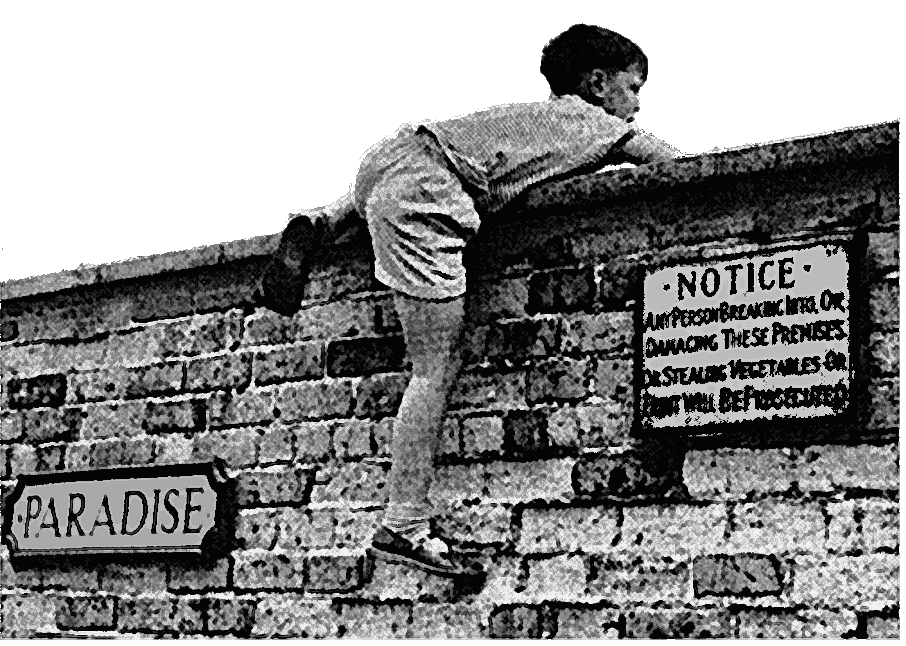
Why does it take an eighteen year-old to say what the many leaders of this movement should have been saying for years? Because she is not mentally bound by past compromises; and is able to turn that clarity into a force for action rather than self-censorship. Though few of those leaders will accept this reality, and their own past failure to speak this message.
THE FOURTH NECESSARY REALIZATION: A more radical youth movement is arising that innately perceives the original ‘deep ecological’ values of the 1970s, and who will not be silenced in promoting them – but society offers them no viable ‘alternative model’ to strive for.
You cannot ‘redistribute’ a deficit
A ‘shallow view’ of the land issue says, “if only the land/wealth were more fairly shared things would be so much better”; neglecting to point out that the major cause of global ecological damage is that there is too much ‘wealth’ already.
A new wave of revisionist Marxism is trying to paint Karl Marx as some kind of Nineteenth Century ‘green’ thinker. Objectively, this just isn’t true. Then again, far-right pundits are trying to paint fascists as the only truly ‘green’ political force.
Read the capitalist theologians who gave rise to modern-day economics – such as John Stuart Mill, or Adam Smith – and it’s clear that all were far more aware of ecological limits than economists today. There’s a simple reason for that: The economists of the Nineteenth Century were trying to overcome material limits to provide ‘sufficient’ food and goods for a (relatively) small population; today economist are trying to fuel growth-at-all-cost to keep affluence expanding.
“Truths are illusions which we have forgotten are illusions – they are metaphors that have become worn out and have been drained of sensuous force”
Friedrich Nietzsche, ‘On Truth and Lie in an Extra-Moral Sense’ (1873)
These physical ‘truths’ about the world humans exist within were forgotten when economics was politicized, as a weapon for state propaganda, in the 20th Century: Mainstream economics denies there are any ‘limits to growth’ – be that resource depletion, or climate change; ‘green’ lobbyists often depict a very similar idea – that all we need to do is change our energy source and everything will be well; social justice campaigners, too, argue that all we need to do is get rid of ‘greedy capitalists’, and redistribute their wealth to everyone else, and all will be well in the world.
These mainly ‘first world’ views of the ecological crisis share a basic flaw: They all ignore the fact the human species is consuming far more of the Earth’s resources than can be sustained by the biosphere without serious ecological damage.

Depending whose data is used, humanity currently consumes 1.5 to 1.7 times the ‘sustainable’ limits of natural resources, or the ability of the Earth to clean-up our pollution. We passed the ‘limit’ for sustainable consumption in the 1970s; this trend has continued to rise, global recessions excepted, since then.
The graph below comes from one of the early studies in 2002; more recent research studies since find the same general trend. This trend cannot continue for very much longer before we destroy the natural systems we rely upon for our survival.
This is a real priority: We have to confront the disconnect between visions for alternate futures, and the failure of those various visions to confront humanity’s excessive material consumption.
We may believe as ‘truth’ that increasing economic growth, and consumption, will make the world better and more affluent for the next generation; in reality they are no more than ‘illusions’, as there is no objective evidence to support them – and certainly beyond 2030 it gets a bit bleak.
The problem for those trying to make ‘change’ is these alternative visions for society take the maintenance of the modern lifestyle as an unquestionable principle. In issue no.5 of just how much we have to cut consumption. Variously for the most developed countries, the estimates indicate 60% to 95% of present carbon emissions/energy consumption must be eliminated. NOTE: Not ‘redistributed’, eliminated.
Trying to compare an affluent state like Britain to other poorer ones is impractical. Most people have not the slightest idea how people elsewhere live; and even foreign holiday resorts tend to represent a level of development and resource consumption way above that of even the more affluent local people.
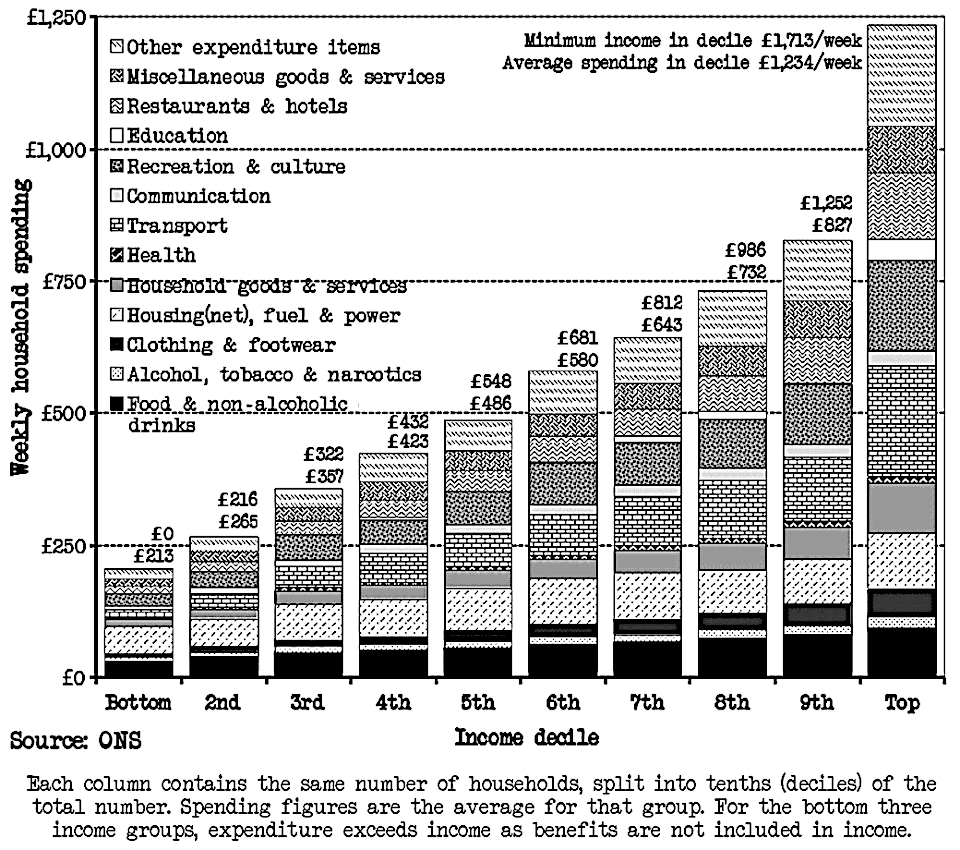
To make this a more realistic comparison let’s look at Britain. The graph, right, using recent Office for National Statistics (ONS) data, shows the expenditure on different parts of the consumer lifestyle by different income groups. Each column contains the same number of households; what divides them is the rising level of income in each household.
As outlined in WEIRD no.5, the poorest 50% of the European population need to cut their consumption by about half. Taking the average of the left five columns (50%) and halving it works out around £174/week.
Let’s be clear here: Even the poorest 10% of British society would see a small reduction to their level of consumption. That’s because, globally, even the poorest British household has/consumes more than households in poorer countries around the world.
The next four columns – the fifth to ninth deciles – need to cut by 75%. This produces about the same level of consumption as the bottom 50%; around £174/week. But that cut represents a complete up-ending of their way of life. In effect, the middle class will have to live like the ‘average’ poor family in Britain.
The remaining top 10%? They have to cut by around 90%, which in terms of today’s perceptions we might describe as “catastrophic”.

That, however, is the entire point:
One of the reasons the COP26 conference failed was that rich countries tried to insulate themselves from the inevitable hard changes required to adapt to climate change. Likewise, poorer countries saw no point in selling such a difficult message to their own – poorer – populations, given that the rich nations were unwilling to commit to such radical change.
THE FIFTH NECESSARY REALIZATION: The material implications of not just climate change, but resource depletion and pollution, require drastic cuts in consumption. That cannot happen without a sense of equity both between and within nations; which means the most affluent have to take the greater hit to their lifestyle.
Change and an ‘ecological’ vision of land rights
An ‘ecological’ vision of land rights isn’t just about the ‘physical’ access to land; it’s as much about what defines ‘property’ and ‘commonality’, both between humans, but more importantly, between all species on Earth – and why present-day politics and economics just can’t see that reality.
Chances are a political coup in a far-away place will have more to do with land rights than politics or ethnic disputes. That’s because the exploitation and expropriation of resources (the “resource curse”), from the poor by rich states, drives political instability in poor countries – not local politics alone. In a world which will become far more resource dependent in the next decade or so – as both technological industrialization and the shift to renewable energy source drive a new global wave of mining and resource extraction – we can assume such geopolitical instability will increase.
To be clear here: Renewable energy expansion will drive conflicts around the issue of land rights and expropriation.
For example: In Argentina, indigenous peoples want to continue their ancient traditional culture based around creating a subsistence living from the land; in contrast, Western countries want to exploit lithium deposits to create electric cars. Who is right here? Whose lifestyle should be given priority?
“We have to understand who we are and where we fit in the natural order of the world because our oppressor deals in illusions. They tell us that it is power, but it is not power. They may have all the guns and they may have all the racist laws and judges, and they may control all the money, but that is not power. These are imitations of power and they are only ‘power’ because in our minds we allow it to be power.”
John Trudell, ‘We Are Power’ (1980)
Too many ‘first world’ pundits define land rights within a strict boundary of land ownership and access. This ignores the principle issue: People want land to exploit for one resource or another – be it coal, cucumbers, or camping. You cannot separate the impact or value of these complex competing desires for land, and the human economic or political function that serves, from the actual ‘control’ of the land itself.
In Britain there’s another good example – grouse moors: The government subsidize grouse moors which benefit an elite shooting lobby, and the management of grouse moors clearly causes ecological damage; but in contrast, those who argue for the end of this practise don’t have a clear, ‘productive’ use of that land. Even ‘rewilding’ the land would create progressive changes in habitat which would threaten the plant and animal species that have been established under two centuries of management for grouse.
This is the critical point: Changing human society will change the natural ecology of the land we live upon – which is why those changes must take place. We cannot keep the land ‘as is’ and simply manage a few nature reserves at the periphery to meet ecological goals.
In the previous article the cuts to lifestyle, based upon current incomes, showed even the poorest 10% need to take a small reduction to meet global goals. The problem is, those people will consider that change relative to the lifestyle they have today – and will, of course, be pretty annoyed given they have relatively little to live on already. Just like the indigenous peoples of South America affected by lithium mining, why should they accept that?
This is why we need a radical vision for change: Not abstract technofixes or global emission limits; but a true alternative to today’s consumption-enforced economic inequality.
What practically makes it hard to be poor in Britain is the iniquitous disparity between incomes and housing costs; or the costs of good, nutritious food versus the types of foods which are available to most poor communities. These are ‘land rights’ issues: They are issues of access to land (housing); access to resources (food); and of the commonality of social resources (the nature of the communities they are forced to live within by the current economic model).
Just as we can’t end grouse shooting without changing the fundamental nature of the moors; we can’t expect the poorest in society to take a small cut to their living standard without tacking the land rights issues which make their current lifestyle physically and psychologically damaging.
Environment and social justice movements try to sell the idea of a more ‘efficient’ lifestyle to a majority of the population – who due to their precarious economic circumstances feel pressured into living anything but that kind of life. To accept the ‘sacrifice’, to end the perceived benefits of unfettered consumerism, society must radically change. Reducing the level of consumption from 1.7 to less than 1 “Earths” can’t be ‘sold’ under any conventional model for change; it doesn’t have a material upside, and in truth must deliver the opposite to be effective. Most will not ‘believe in’ this vision unless it can address the negative aspects of how they feel about their lives today.
Just as they have for the past 70 years, the economic elite in the West will ‘weaponize’ consumerism to oppose radical change. But just as happened in the century before that, when they can no longer defeat calls for radical change with more materialism, they will happily recruit the far-right’s call for protection and isolation to block radical change.
“By means of ever more effective methods of mind-manipulation, the democracies will change their nature; the quaint old forms – elections, parliaments, Supreme Courts and all the rest – will remain. The underlying substance will be a new kind of non-violent totalitarianism. All the traditional names, all the hallowed slogans will remain exactly what they were in the good old days. Democracy and freedom will be the theme of every broadcast and editorial – but democracy and freedom in a strictly Pickwickian sense. Meanwhile the ruling oligarchy and its highly trained elite of soldiers, policemen, thought-manufacturers and mind-manipulators will quietly run the show as they see fit.”
Aldous Huxley, ‘Brave New World Revisited’ (1958)
How do we know this? Because political commentators have been writing about these tactics since the ‘bread and circuses’ of the Roman era. In the Twentieth Century, figures such as Aldous Huxley foresaw the slow changes in civility happening today – not because of any great prophetic deduction, but because it is simply these same ‘ancient’ ideas set against a background of growing technological and material change.
The problem with (predominantly middle class and affluent) ecological thinkers is that they do not perceive this dynamic balance in modern society. In particular, they do not understand how today’s precarious economic situation makes people wary of any call for change – and that contemporary political lobbying exploits that fear to block calls for more radical change.
Environmentalists are convinced their moderate and ‘rational’ calls for change can’t be objected to because it is a ‘life or death’ issue. This ignores the reality that the raw political power of consumerism is not based upon rational, but a ‘liminal’ (a break or threshold in personal status) rejection of “limits” in order to keep consuming.
Just as economists reject any any notion of limits to growth, so consumers play this same game within the orbit of their own lifestyles.
The ‘credit limit’ is the perfect example of this: Today there is an entire industry creating ever more elaborate ways to avoid the very real limits to personal borrowing – from loan consolidation, to gaming credit scores, to equity release. People willingly engage in ever-more complex financial schemes to keep consuming, by holding more debt, even though ‘rationally’ the know this situation cannot continue. Now extend that approach to climate change, and think why affluent societies won’t act on it.
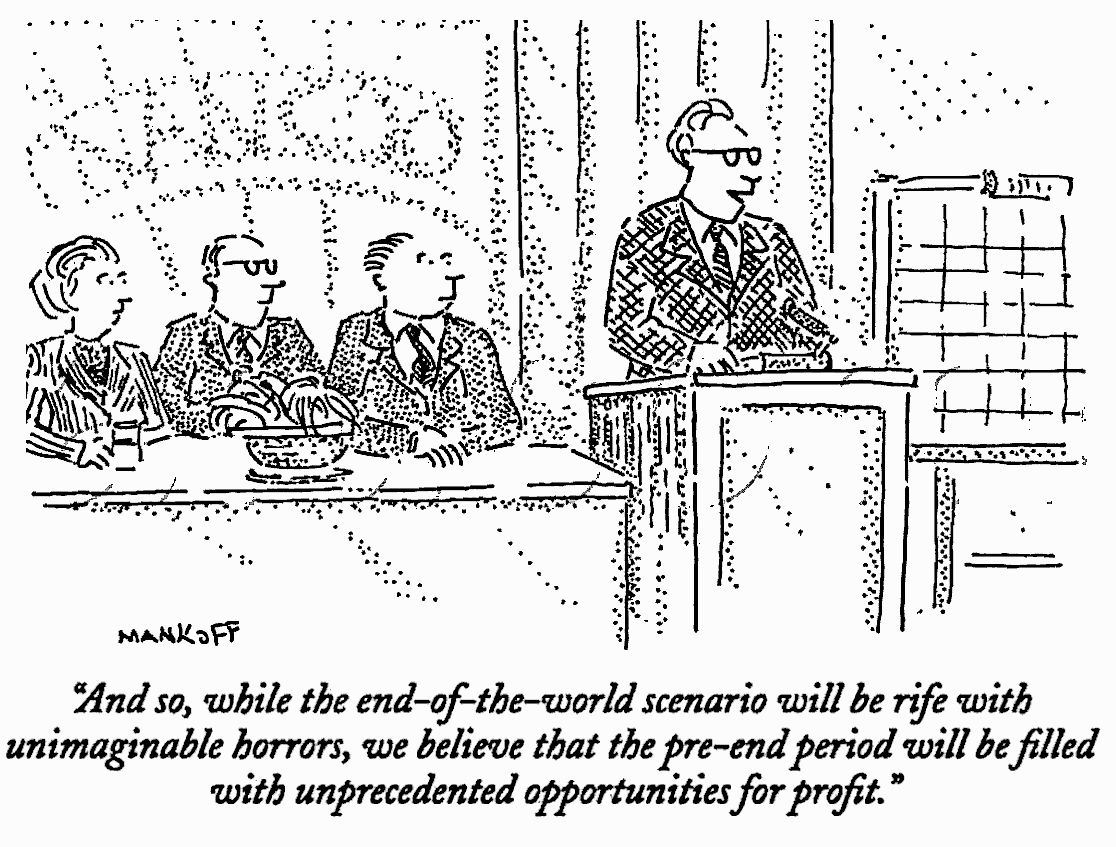
There is little relative difference between climate change denial, the denial of ecological limits by neoclassical economists, and people racking up debt across a dozen store cards: They are all symptoms of the psychological power of consumption and affluence to over-ride rational thought; which drives people to push ‘limits’ ever-further; and defeat ‘rational’ calls to end that self-defeating cycle by changing lifestyle.
As the ecological situation worsens, those with true economic power will seek to preserve it – and that means making the conditions for those in the most affluent countries worse.
The rise of digital platforms, ‘surveillance capitalism’, and the greater private powers of global corporations, changes the nature of “liberal democratic” society – which to date mainstream environmentalism has failed to grasp. E.g., returning to the question about Argentina, and whose lifestyle takes precedence: On the 2019 Bolivian coup, engineered by the US as a means to access their large lithium resources, Elon Musk Tweeted in 2020, Whether they like this fact or not, campaign groups who lobby for more renewable energy are encouraging that same political reality.
As Western corporations seek to exploit the resources necessary to create the ‘Green New Deal’, they are engaging in a geopolitical battle with other states rushing to access those same limited resources. Even in Britain, protected landscapes in Wales and Scotland will need to be cleared of trees and dug up to access the globally significant quantities of minerals they contain. While we fail to question the political and economic basis of society, that push for exploitation around the globe cannot be halted – because that system IS IMPLICITLY based on the neocolonialist exploitation of global resources.
The ruling elite in Britain have always used mythical statements about economic power, and the role of ‘private property’, to perpetuate economic inequality. In order to break that self-perpetuating cycle we have to challenge those illusions; not find illusory technofixes which meet those perverse rules to avoid having to talk about them.
THE SIXTH NECESSARY REALIZATION: Against the power of economic dogma to warp people’s perceptions, ‘rational’ calls for action are pointless. In fact, as the economic situation worsens, alternative viewpoints are being more repressively restricted – especially challenges to the orthodox ideas of neoclassical economics. We don’t need ‘better facts’; we need ‘a better story’.
A truly ecological society cannot exist while proprietary rights persist
If ecological thinking, or calls for greater or more equitable land rights, failed, then it is not because they are ‘unreasonable’; it is because they have been far too reasonable in their call for change. Creating a truly ecological society requires we tear-down the barrier which stands in opposition to that – ‘proprietary rights’.
The ‘Declaration of the Rights of Mother Earth’ is spurned by Western states because it attacks the core of the economic and political order: Not the state; nor technological change; but the thing which holds Western economic power together – ‘property rights’:
If rivers have rights you can’t throw pollution into them; if people’s autonomy must be respected you cannot exploit them or steal their land; if natural species and habitats have a ‘right to exist’, they can’t be cleared for intensive farming or genetically exploited to make them the property of a corporation.
“You can’t talk about hope if you can’t see reality”
Neoclassical/liberal economics demands a ‘small state’ and the primacy of markets to make decisions. In reality, without the state, and the state’s monopoly on violence both nationally and globally, neither private property, the global finance system, nor the power of globalized resource markets, would exist. As the people and parties who represent the political state, and their wealthy sponsors, worship the raw power of proprietary rights, any call to lessen the ideological power of ‘property’ is going to be ignored.
‘Green capitalism’ goes further: Privatising the stock of global resources to perpetuate global inequalities in wealth and consumption – be that mining metals for green energy or annexing land for carbon off-setting.
Countering this isn’t about rational arguments on the relative costs of “the end of the world” (which take property rights as a ‘given’ anyway). What we need to target is the social and political contradiction of ‘private property’, and its power to control, expropriate, and dominate people – locking society into self-destructive lifestyles.
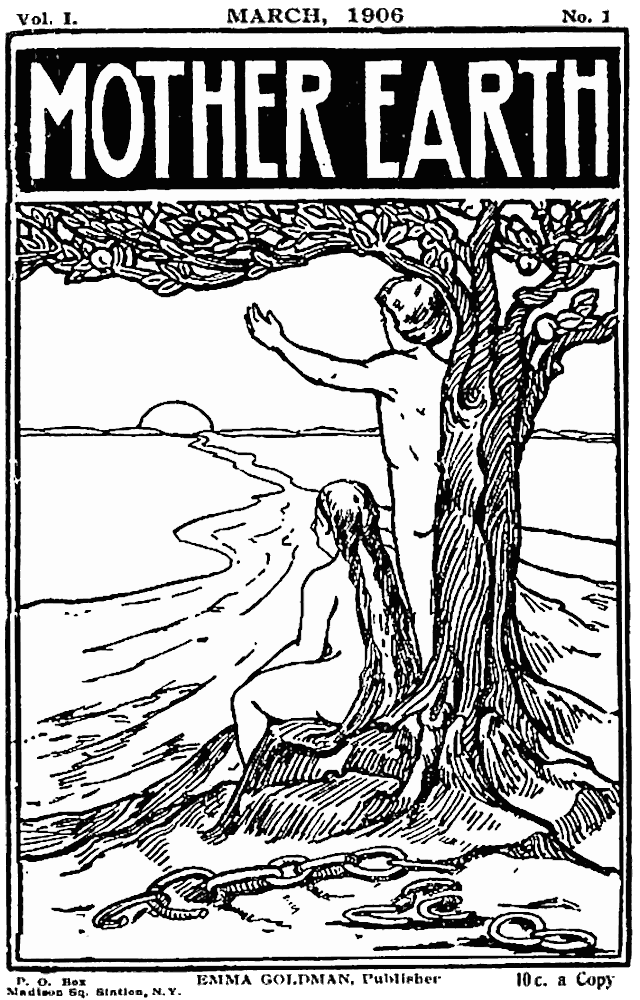
The cover of the first edition of ‘Mother Earth’ – the magazine of anarchist social science and literature, started by Emma Goldman and Alexander Berkman in 1906.
The magazine’s radical stance on politics and power would make it infamous. It published work by many of the greatest anarchist thinkers of that era.
When it campaigned for people to refuse to support World War One, the government closed it down under the Espionage Act – deporting Goldman, Berkman, and 256 other anarchists to Russia during the ‘First Red Scare’ in 1919.
We do that by creating a working model of social organization and economic relations without ‘proprietary rights’; we focus on fulfilling the basic human needs for food, shelter, and civility. For this people need access to land, and the skills to productively work it.
At this point we think a few of you might be a little annoyed: This issue of WEIRD is looking at ‘land rights’, but it’s not talking about the usual tropes of this subject – such as the aristocrats who own Britain, corporations who destroy the world, or battling to protect allotments or public open spaces. Those things are ‘symptoms’ of the problem, not a root cause. It is not possible to separate the inherent violence of the state in the maintenance of property rights, from consumerism, and the destruction caused by the global systems of resource exploitation and pollution.
This is not a new idea: It’s the same idea that has been repeated by anarchist thinkers and activists since at least the Seventeenth Century. What The Diggers inspired almost four centuries ago is equally valid today as it is based within the same basic idea: That to be secure, people need to live simply, and communally, directly from the land.
Anarchist writers since that time have focussed more on meeting the basic needs of the people rather than the industrial models which other socialist movements idolize. That chain of thinking, about the Earth as an ecological whole, and the place of humans within it, is a long-standing tradition within anarchist thought and organising.
The ‘liberal’ response to this idea is usually, “but no one will vote for that”. The reply, put simply, would be, “When did ‘the will of the majority’ ever change anything in this country?” Seriously, when?
The last British election where a single party had a majority of the electorate vote for them was the 1930s. Most recent governments were elected with as little as 30% support from those eligible to vote (see the Free Range Network’s article, “We live in a democracy”: Can you show me some evidence of that?). The idea of ‘majoritarianism’ – the largest group elects a government – comes from the Cold War mythology of the democratic state. It is not borne out by historic evidence; making the impossibility of ever having ‘a majority’ a very effective block to radical change.
The ‘cradle of democracy’, ancient Athens, allowed 10% to 15% of the population to vote – and perhaps half of the total population were held in slavery.
Following the English Civil War, the English political system was run by and for the landed aristocracy. When that became untenable in the Industrial Revolution, it shifted to a system based upon wealth. It is during this period that property was legally enshrined as the organising principle for the British state, because that’s what those in charge valued above all else.
Let’s assume, for the sake of argument, that a radical majority arose in Britain; and they voted for a government which sought a radical change in the role of property and the state. What then?
For the last seventy years Britain and/or the USA have worked to destabilized governments across the world. In nearly all cases this is where ‘nationalist’ movements sought to roll-back colonialist control – or they defied the dictats of the Western economic block.
The USA has directly supported military coups in Iran (1953), Guatemala (1954), Brazil (1964), Bolivia (1971), Chile (1973), Argentina (1976), Haiti (2004), and Honduras (2009). On the 23rd June the UN General Assembly voted to end the USA’s unlawful economic sanctions against Cuba – for the 29th time! If there is no legal basis to the US sanctions against Cuba, and their punishment of any state or business which violates them, what is the power of the UN’s majority voting?
If voting did create the opportunity for radical change, chances are they wouldn’t ban it, the establishment would just overturn it in a coup – with the support of the USA and other economic interests.
To rely on conventional political processes to deliver radical change – certainly within the time we have before the human system suffers ecological collapse – has no rational sense. More than that, given the political process is based upon the notion of a ‘social contract’, and the modern state is breaching it’s obligations under that contract for our future safety, we are not bound to this system in any case.
We have to think beyond those old ‘distractions’, and circumvent the restrictions of the political process through direct action: To create a critical mass of empowered and re-skilled people, ready to create autonomous communities when the chance arises.
What can we reasonably expect to face of the next decade or so?:

- Western states will not make an effective deal on climate change – certainly not in time to prevent serious climate disruption;
- At the same time other ecological limits, especially resource depletion, and the collapse of global manufacturing and logistics systems, will challenge the affluence of all developed states;
- As the necessity to adopt technologies based on ever-rarer materials drive a new global mining boom, geopolitical conflict is likely to rise in the contest to get those resources; which means,
- As we have seen with the rise of populist political movements recently, when the economic entitlement of the Western states is challenged, wealthy individuals give support to far-right movements, or media outlets, in order to try and perpetuate their control of the economic system – and we need to survive that.
Each one of the trends above can be countered if people can create small communities – based upon the many practical solutions from permaculture to open source design. Yes, we can’t stop climate change – but we can more readily adapt to it working at the small-scale with others. And yes, we can’t stop economic collapse of the modern state, but we can make a more secure alternative based upon communities making their own food and shelter.
In a state such as Britain, though, that is not possible due to the economic barriers of obtaining land, and then creating a small community upon it. The role of property rights – both over land, and ideas in the form of ‘intellectual’ rights – is a critical restriction here.
“The strongest bulwark of authority is uniformity; the least divergence from it is the greatest crime. The wholesale mechanization of modern life has increased uniformity a thousandfold. It is everywhere present, in habits, tastes, dress, thoughts and ideas. Its most concentrated dullness is “public opinion.” Few have the courage to stand out against it. He who refuses to submit is at once labelled “queer,” “different,” and decried as a disturbing element in the comfortable stagnancy of modern life.”
Emma Goldman, ‘The Individual, Society and the State’ (1940)
We have to think beyond those applied limitations. The first step to doing that is to realize ourselves as living beings, with the practical needs of living beings – not voters, or consumers, or workers. Then the choices for ‘sustainability’ become simpler; and as we free ourselves of the superstructure of our historic exploitation, and the imperative of material consumption, we remove the need to maintain those historic injustices within our lifestyle.
This isn’t going to be a ‘revolution’ all at once; it won’t happen overnight, or over the space of a year or two. It will take time to evolve because – quite literally – people will need to assess their best option, and then re-skill to enact that option, and then create it.
THIS LEADS TO THE SEVENTH NECESSARY REALIZATION: We don’t have to ‘wait for the revolution’ to get on with the process of re-skilling for radical change. It’s plain to see which skills and actions we need, and then get on with learning and doing them right away!
All those traditional ideas about creating more sustainable lifestyles – like permaculture – will be essential in this. But in order to learn them, to prepare for when we can overturn the present system, we need direct action to create ‘temporary autonomous zones’ (‘TAZ’) where we can directly live these ideas. This is where long-standing anarchist ideas for organising and taking action are essential.
In conclusion – Change is hard, but in the near future inaction will be a lot worse
Anarchist principles provide the most effective means to order from the chaos of the collapse of industrial society.
This issue of WEIRD has provided some weighty ideas to consider. As we said at the beginning, in order to make sense of this you should have read Issue no.5 – because that sets-out the scale of the change we face over the next two or three decades.
Conventional politics can’t find a solution to climate change – let alone any of the other ecological crises that are ‘in the post’ – because its values are flawed. These values: Prioritize ‘inhuman’ factors, like financial wealth and economic power; and de-prioritize the needs that are essential to our lives as ‘natural’ beings, like having sufficient food and shelter for everyone, and a liveable environment to provide those things.
To begin, let’s recap the list of ‘realizations’ listed earlier:
- Meaningful change can only happen when we ignore historic or popular assumptions, and focus on real-world evidence.
- If there is a way out of our entrapment in this economic prison, as far as you possibly can, you can only refuse to take part in it.
- Britain is being consumed by intensive farming interests, presided over by a small landed elite.
- A more radical youth movement is arising that innately perceives the original ‘deep ecological’ values of the 1970s, and who will not be silenced in promoting them – but society offers them no viable ‘alternative model’ to strive for.
- The implications of not just climate change, but resource depletion and pollution, require drastic cuts in consumption. That cannot happen without a sense of equity both between and within nations – which means the most affluent have to take the greater hit to their lifestyle.
- Against the power of economic dogma to warp people’s perceptions, ‘rational’ calls for action are pointless. Alternative viewpoints are being more repressively restricted – especially challenges to the orthodox ideas of neoclassical economics. We don’t need ‘better facts’; we need ‘a better story’.
- We don’t have to ‘wait for the revolution’ to get on with the process of re-skilling for radical change. It’s plain to see which skills and actions we need, and then get on with learning and doing them right away!
“What makes us ill, justifiably, is the sense that that Old Regime is coming to an end. The concept of ‘nature’ now appears as a truncated, simplified, exaggeratedly moralistic, excessively polemical, and prematurely political version of the otherness of the world to which we must open ourselves if we are not to become collectively mad”
Bruno Latour, ‘Facing Gaia: Eight Lectures on the New Climate Regime’ (2017)
A number of academics, such as Bruno Latour, are focussing on these points. The reason governments put so much effort into environmental research, on issues like climate change, is that by quantifying the problem you can ‘negotiate’ how much you need to change. The problem is, that process of finding information actually defeats change – because it delays action, and ultimately leads to debate on how little change we can get away with rather than what is required to solve the problem.
Once you measure and quantify nature, from a perspective based within proprietary rights, you end-up parcelling it up and economically exploiting it – rather than dealing with the problem that was destroying it. It leads to actions that preserve the status quo instead of protecting nature.
Too often, calls for change take the current lifestyle as a constant – and try to replicate those things by other means. After fifty years of prevarication, now it’s too late to stop the inevitable: Now we can only try and take steps to adapt to imminent ecological breakdown.
In reality, as both lifestyle and economic status have historically been created by the excess of consumption of a minority, it’s unrealistic to assume we can keep it. As shown in Issue no.5, it is theoretically impossible to have affluence for all using technology. As summarized in Issue no.5:
We are not in a situation of having ‘problems’ with ‘possible solutions’; we are in a ‘predicament’ with only a few, mostly unwelcome ‘outcomes’ to choose from.
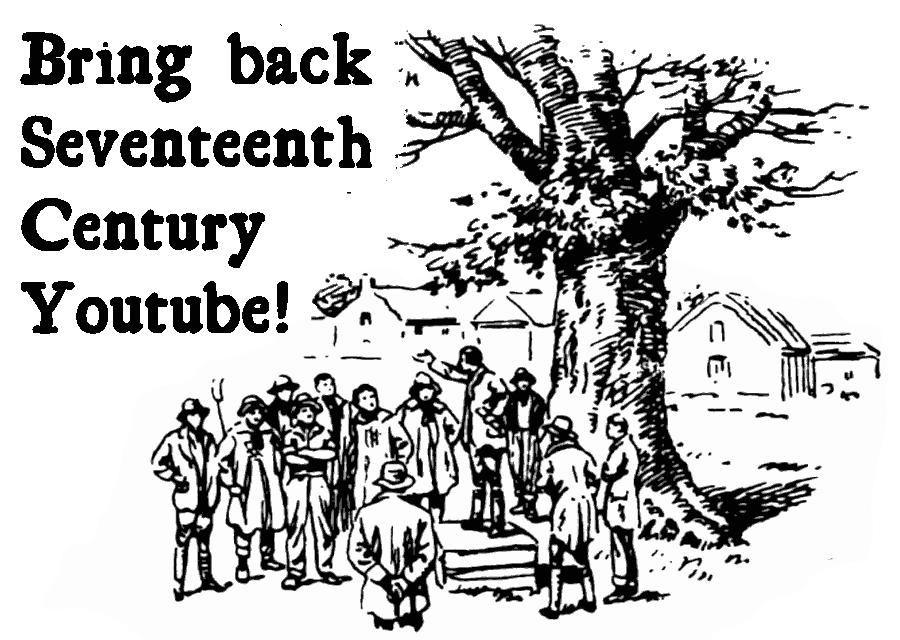
What we’re talking about, then, is creating a system for living which prioritizes ‘needs’ over ‘wants’ – as envisioned in the first UN ‘sustainable development’ report in 1987. But when we practically try to do that, because it requires a closer relationship between people, the land, and natural systems, we automatically hit the barriers erected by the current economic system.
That’s why we need a focus on all ‘property rights’ – not just over land, but over ideas, and the use of everyday items that obstruct our right to repair or reuse them. But that shouldn’t stop us doing things right away.
Of course, ‘the system’ will not let us do that; in which case we just have to defiantly do that, as a challenge to their historic failure to enact meaningful change. From guerilla gardening, to free festivals, to land occupation, we just have to get on and make the world we will all have to live in.
W.E.I.R.D.: THINKING BEYOND TECHNOLOGY – No.6, Yule 2021
A Free Range Activism Network Publication. Download other editions of ‘WEIRD’ at http://www.fraw.org.uk/frn/weird/index.shtml. Email any comments or feedback to weird☮frăwꞏörĝꞏuk. Issued under Creative Commons BY-NC-SA-4 license; you may freely distribute.