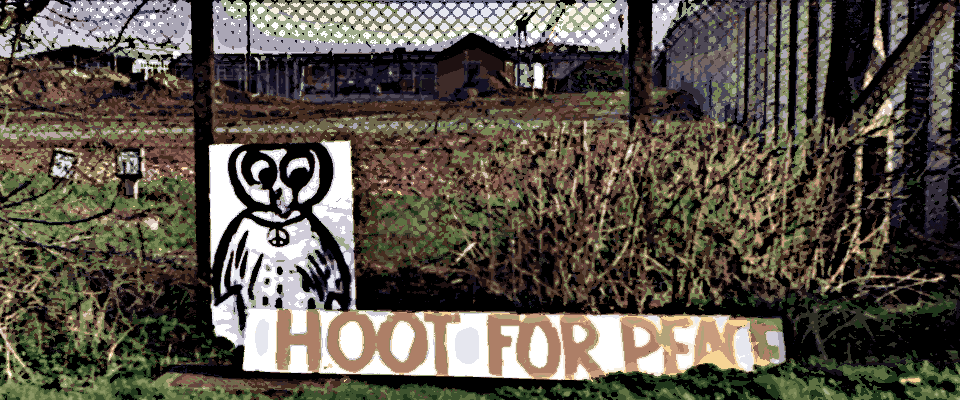
Simply confronting, and publicly witnessing what is being done in our names can cause deep problems for ‘the establishment’ (the peace camp at USAF Upper Heyford nuclear bomber base, late 1980s)
In England & Wales the only cheap, easily available space for anyone to learn the skills of simple living is ‘the outdoors’; and right now the Whitehall government is trying to criminalise ‘free camping’ in the open countryside.
It’s time for activists to reclaim the deep ecological roots that inspired the environment movement, and create the resources and energy that supports humans, not machines.
Published by Ivan Illich in 1973, ‘Tools for Conviviality’ is a book on human society, the growth of sophisticated technologies, and the ecological crisis.
When everything is reduced to an economic value, only that abstract value has relevance to political debate – which is what excludes most people from politics.
There are between ten and twenty ecological trends, any one of which could collapse the ‘modern’, technologically-enabled human system. Why then focus most of our energies on just one?
Introducing this special third edition, investigating ‘Britain’s Energy & Climate Crisis’, to demonstrate that neither side in this heated debate cares about statistical reality, or its deeper meaning.
What the national energy statistics do not fully capture is lifestyle – and how lifestyle influences emissions. Common sense says we must create our own ‘lifeboat’ options instead.
The only cheap, available space for anyone to learn the skills of simple living is ‘the outdoors’ – and the Whitehall government is trying to criminalise that.
There are between ten and twenty ecological trends, any one of which could collapse the ‘modern’, technologically-enabled human system. Why then focus most of our energies on just one?
It’s time for activists to reclaim the deep ecological roots that inspired the environment movement, and create the resources and energy that supports humans, not machines.
When everything is reduced to an economic value, only that abstract value has relevance to political debate – which is what excludes most people from politics.
A ‘shallow view’ of the land issue says, “if only the land/wealth were more fairly shared things would be so much better”; neglecting to point out that the major cause of global ecological damage is that there is too much ‘wealth’ already.
If ecological thinking, or calls for greater or more equitable land rights, failed, then it is not because they are ‘unreasonable’; it is because they have been far too reasonable in their call for change. Creating a truly ecological society requires we tear-down the barrier which stands in opposition to that – ‘proprietary rights’.
Introducing this special third edition, investigating ‘Britain’s Energy & Climate Crisis’, to demonstrate that neither side in this heated debate cares about statistical reality, or its deeper meaning.
Everyone loves renewable energy, don’t they?; but few really understand its relative scale of its contribution to energy supply, and certainly not the sometimes gruesome details of its production.
The film ‘Planet of the Humans’ caused a storm in green circles. What they failed to realise was the character of their response actually accentuated the film’s arguments.
What the national energy statistics do not fully capture is lifestyle – and how lifestyle influences emissions. Common sense says we must create our own ‘lifeboat’ options instead.
The economics of ‘fast’ food are not based upon the ingredients, but upon the business model of mass marketing via superstores. Creating a different way of living means confronting the absurdities of that system.
Everyone loves renewable energy, don’t they?; but few really understand its relative scale of its contribution to energy supply, and certainly not the sometimes gruesome details of its production.
The film ‘Planet of the Humans’ caused a storm in green circles. What they failed to realise was the character of their response actually accentuated the film’s arguments.
Published by Ivan Illich in 1973, ‘Tools for Conviviality’ is a book on human society, the growth of sophisticated technologies, and the ecological crisis.
How do you talk about freeing ourselves from the gadgets that define our lives, when the way everyone communicates these days is defined by those gadgets?
An introduction to this second edition, where we directly ‘welcome to extinction’ of what passes for normality, in the hope that people will move on and organise for something better.
Introducing this special third edition, investigating ‘Britain’s Energy & Climate Crisis’, to demonstrate that neither side in this heated debate cares about statistical reality, or its deeper meaning.
We are not in a situation of having ‘problems’ with ‘possible solutions’; we are in a ‘predicament’ with only a few, mostly unwelcome ‘outcomes’ to choose from.
In England & Wales the only cheap, easily available space for anyone to learn the skills of simple living is ‘the outdoors’; and right now the Whitehall government is trying to criminalise ‘free camping’ in the open countryside.
An ‘ecological’ vision of land rights isn’t just about the ‘physical’ access to land; it’s as much about what defines ‘property’ and ‘commonality’, both between humans, but more importantly, between all species on Earth – and why present-day politics and economics just can’t see that reality.
If ecological thinking, or calls for greater or more equitable land rights, failed, then it is not because they are ‘unreasonable’; it is because they have been far too reasonable in their call for change. Creating a truly ecological society requires we tear-down the barrier which stands in opposition to that – ‘proprietary rights’.
In England & Wales the only cheap, easily available space for anyone to learn the skills of simple living is ‘the outdoors’; and right now the Whitehall government is trying to criminalise ‘free camping’ in the open countryside.
In the wake of the pandemic, as in the wake of the 2008 Crash, neoliberal capitalists have become socialists. However, does the great idea of the left, ‘Universal Basic Income’, represent anything better?
Everyone loves renewable energy, don’t they?; but few really understand its relative scale of its contribution to energy supply, and certainly not the sometimes gruesome details of its production.
Published by Ivan Illich in 1973, ‘Tools for Conviviality’ is a book on human society, the growth of sophisticated technologies, and the ecological crisis.